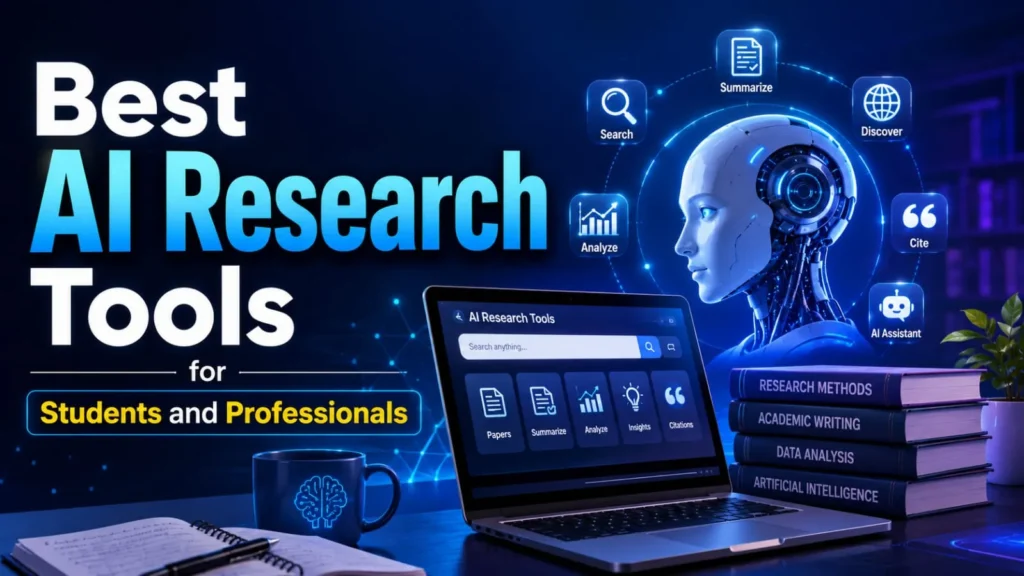
In my experience, a normal Google search is good, but it takes too much time to filter real information from junk. This is where AI Tools for Research come in handy. They read, summarize, and even organize information for you in minutes.
Here are some quick highlights of what these tools can do:
- Find real academic papers in seconds.
- Summarize long research papers into simple points.
- Give you proper citations, no guesswork.
- Help in literature review and data analysis
- Save hours of manual searching.
If you think as I do, time is the biggest thing we lose while doing research. So using the right tool is not a luxury anymore; it’s a need.
Best AI Research Tools for Students and Professionals
Now let’s talk about the actual tools. I have used many of these personally, and I will give you an honest opinion, good and bad both.
Elicit - Best for Structured Research
Elicit is one of the most trusted AI Research Assistant tools out there. You can ask a research question, and it searches through millions of papers to give you relevant answers with proper data extraction.
Good: It is very accurate and shows real sources, no fake information.
Bad: The free version has limits, and for heavy use you need the paid plan.
Semantic Scholar - Best Free Option
If you are a student and want something free, Semantic Scholar is great. It uses AI to understand papers and connects related research together.
Good: Completely free and covers a huge academic database.
Bad: The interface can feel a bit basic compared to paid tools.
Consensus - Best for Quick Answers
Consensus is perfect when you want a fast answer backed by real studies. You type your question, and it shows what research actually says, including if studies agree or disagree.
Good: Very fast and easy to understand for beginners.
Bad: Not deep enough for detailed academic writing.
ResearchRabbit - Best for Discovering Papers
This one is like a map for research papers. You start with one paper, and it shows you a whole network of related studies. I used this while working on a project, and honestly, it helped me find papers I would have never found on Google.
Good: Great for visual learners and connecting ideas.
Bad: It’s more for discovery, not for writing or summarizing.
NotebookLM - Best for Organizing Research
NotebookLM lets you upload your documents and directly ask questions based on the info in them. It’s like having a personal assistant who has already read all your files.
Good: Very helpful for managing your own notes and sources.
Bad: Works best with a limited number of documents at a time.
Best AI Academic Research Tools for Literature Review
Now, if you are working on a literature review or thesis, you need tools that go one step further. This is where Best AI Tools for Students doing serious academic work should focus.
- Use Elicit or Semantic Scholar to find and shortlist papers.
- Use ResearchRabbit to explore connected studies.
- You can use NotebookLM to keep your notes and sources organized.
- Use Zotero (a classic tool, not AI, but works perfectly with these) to manage citations.
However, one thing I always tell people: do not fully depend on AI. Always double-check the sources yourself. AI can sometimes make mistakes, so always double-check yourself one last time before using anything.
Which AI Research Tool Should You Actually Pick?
This is the question everyone asks me. To be honest, there isn’t a completely correct or perfect answer here. It depends on what you need.
If you want free and simple, go with Semantic Scholar or Consensus. If you want deep and structured research, Elicit is a strong choice. If you want to organize your own files and notes, NotebookLM works well.
In my experience, using two or three tools together works better than depending on just one. Think of it like a team; each tool does its own job well.
Are AI Research Tools Reliable for USA and India Users?
Yes, most of these tools work the same way for both USA and India users since they are based on global academic databases. However, internet speed and access can be slightly different depending on your location.
Also, keep in mind these tools are best used as an assistant, not a replacement for your own thinking. The Best AI Research Tools can save time, but the final understanding still comes from you.
Final Thoughts
So buddy, this is my honest opinion about which are the best AI research tools currently available—there’s no definite answer to this because you should choose according to your own needs and budget.
I’ve personally used most of these, and they really make research faster and smarter. But remember, it’s very important to always check the facts yourself before submitting any work. Technology is helpful, but your own decision according to your needs is the most important.
Disclaimer
This article is based on personal experience and general research. Tool features, pricing, and free limits may change over time, so please check the official website of each tool before using it for important academic or professional work.