Tech all rounder

Snapdragon vs MediaTek: Which Mobile Processor Is Better in 2026?

Snapdragon vs MediaTek processor comparison 2026 mobile chipset

Buddy, if you are planning to buy a new phone, there is one question that comes up almost everywhere: Snapdragon vs MediaTek. Every year both companies launch their new chips, and both claim their processor is the best. Tell me the truth, you also get confused when you look at a spec sheet, right? In my experience, the answer to this confusion is not as complicated as it looks. In this article, we will look in simple words at which processor performs better in gaming, battery life, camera, and daily use, so you can easily decide. Article Highlights Snapdragon is strong in peak performance and single-core speed. MediaTek Dimensity 9500 has come out ahead in overall score in several benchmarks. Both have strong GPUs for gaming, but the experience is a bit different. MediaTek stays cooler and more efficient on battery in many devices. Both India and USA flagship phones now use both chips. Snapdragon vs MediaTek What Is the Real Difference? Snapdragon is Qualcomm’s processor, while the Dimensity series is made by MediaTek. The latest flagship comparison is between the Snapdragon 8 Elite Gen 5 vs MediaTek Dimensity 9500, and both of these are going into most Android flagship phones in 2026. There was a time when MediaTek was seen as only a budget phone processor. But that idea is old news now. The Dimensity 9500 has shown strong numbers in several benchmark tests, and in some cases it has even beaten Snapdragon in total AnTuTu score. Performance and Benchmark Comparison This is where things get mixed, and honestly this is the most interesting part. In some tests, the Dimensity 9500 gave a better Geekbench single-core and multi-core score than the Snapdragon 8 Elite, and the total AnTuTu score was also higher. On the other hand, when it comes to the Snapdragon 8 Elite Gen 5, early benchmarks went in Qualcomm’s favor in both CPU and GPU, and most phones at the beginning of 2026, smartphones with Snapdragon processors, proved to be the strongest in the AnTuTu flagship ranking. In simple words, both chips are top-tier, and in real life the difference is not as big as the numbers make it look. Gaming Performance Snapdragon vs MediaTek Gaming performance: Snapdragon vs MediaTek which chip handles heavy games better? If mobile gaming is your first choice, then the information ahead matters the most to you. Snapdragon gives strong graphics output with its Adreno GPU, and its ray tracing support is solid too. MediaTek’s Dimensity 9500 also supports high frame rate gaming with its Mali-G1 Ultra GPU. My personal experience has been that both chips run heavy games like BGMI or Genshin Impact smoothly, but heat control feels a bit better on MediaTek phones during long gaming sessions. Battery Life and Efficiency This point is a deciding factor for a lot of people. In my experience, MediaTek chips generally stay a bit cooler and also give slightly better battery life in daily use, like scrolling, streaming, and calls. Snapdragon is efficient too, but it can get a bit warmer during peak performance, especially during heavy gaming. Also Read: Snapdragon 7s Gen 4 vs Dimensity 8350: Benchmark, Score & Best Processor 2026 Camera and AI Features Both chips have modern ISPs and NPUs that improve camera quality and AI processing. MediaTek’s chip supports high resolution cameras and can record 8K video, while Snapdragon also offers camera and video support at the same level. AI features like on-device processing, background blur, and smart photo editing work well on both. Comparison Table Feature Snapdragon (8 Elite Gen 5) MediaTek (Dimensity 9500) CPU Peak Performance Strong single-core Strong multi-core, close overall Gaming GPU Adreno, ray tracing Mali-G1 Ultra, high frame rate Battery Efficiency Good, warm under load Slightly cooler, efficient Camera/ISP Up to 320MP, 8K video Up to 320MP, 8K video Market Presence In most flagship phones Growing fast, in some flagships What Makes the Lava Virat V1 Series Special Snapdragon Pros and Cons Pros: Strong peak performance Good ray tracing gaming experience Available in more phones across India and USA Cons: Can heat up a bit more under heavy use Some models are priced higher MediaTek Pros and Cons Pros: Cooler thermal performance Good battery efficiency Top-level benchmark scores in many cases Cons: App optimization is still not as wide as Snapdragon Some users still worry about emulator support, though newer Dimensity chips have improved on this Also Read: Realme 16x 5G Tipped for India Launch with Big Battery Verdict Snapdragon or MediaTek, Which Is Better? Rating: 4.3 out of 5 (for both processors overall) If you think like I do, honestly both processors are flagship level in 2026, and a normal user will not feel much difference in day-to-day use. If you are a heavy gamer and want ray tracing, Snapdragon is a good choice. If you want battery life and cooler performance in a budget-friendly flagship, MediaTek’s Dimensity is a solid option. Disclaimer: This article is written based on general information and available benchmark data. Actual performance may vary depending on the device model, software optimization, and usage pattern. Please check the latest reviews and consider your budget before buying. Related Post Realme 16x 5G Tipped for India Launch with Big Battery Realme P4s Lite Could Be the Next Big Budget Phone: Here’s What We Know OnePlus 16 Availability: Should You Still Buy It After the Market Exit? Best Battery Phones That Keep Going Long After Others Quit iQOO 15 Ultra Global Launch Leak: Big News for Fans 1 2 Earbuds Huawei FreeClip 2 S Early Bird Offers Now Live OPPO Enco Air 5 India Launch Confirmed: Amazon Teaser is Live! 5 Best Earbuds of 2025: Sound, Battery, and Reviews Top 10 Earbuds in India 2026 – Best Wireless & Budget Picks Vivo Over-Ear ANC Headphones: 7 Powerful Features Revealed 1 2 Laptops Lenovo Legion 7a RTX 5070: Big Gaming Upgrade Save Up to Rs 20,000 on MacBook Air M5 Discount Deal Best Gaming Laptops Under $900 Worth Buying Today Lenovo … Read more

Samsung or Apple? One UI 9 vs iOS 27 Full Comparison Guide 

One UI 9 vs iOS 27: Amazing Features Compared

Hey friend, if this year you’re stuck between Samsung vs Apple phones, you’re not alone. Everyone I know is asking the same thing, One UI 9 vs iOS 27, which one should I get? I get it, this decision isn’t easy because both companies have given some solid updates this time.    In my experience, choosing between the two mostly depends on how you use your phone daily and for what purpose, not just which one looks cooler on paper and then buying it for that reason. So let’s break down One UI 9 vs iOS 27 in an easy way, no technical jargon, just simple stuff like I’m telling a friend over morning tea.  Highlight key One UI 9 has new designs, more intuitive multitasking, and smarter AI features than before.  iOS 27 focuses on deeper AI integration, smoother animations, and privacy upgrades  Both systems now offer longer software support, up to 6-7 years  Battery optimization has improved on both sides  Customization is still Samsung’s biggest strength  What’s New in Samsung’s One UI 9? Samsung has actually listened to user feedback this time. One UI 9 feels lighter and faster compared to older versions. The notification panel is cleaner, and Samsung has trimmed down a lot of the bloatware that used to slow things down.  Tell me the truth, have you ever felt your Samsung phone becoming laggy after a year of use? That has been a real problem for many of us. Looking at the features of One UI 9, Samsung claims that it offers better RAM management and smooth animations, and to be honest, I tested it on my cousin’s (maternal uncle’s son) Galaxy phone, and Samsung was actually right about it.  The AI features are also stronger now. Samsung has added smarter photo editing tools, better voice assistant responses, and quicker app suggestions based on your habits.  One UI 9 Design and Customization If you love changing your phone’s look every few weeks, Samsung still wins here. You get more lock screen options, better widget control, and deeper theme customization. Apple users often ask me why they can’t do this on iPhone, and honestly, that’s just Apple’s style, they like to keep things simple and controlled.  Also Read : Premium iOS 27 Public Beta Benefits You’ll Love What Does Apple’s iOS 27 Bring to the Table? Now let’s talk about Apple’s side. iOS 27 features focus heavily on AI, privacy, and a smoother overall experience. Apple has improved its on-device AI processing, which means many features now work without needing internet, and that is a big win for privacy lovers.  If you think like I do, privacy really matters in 2026. With so many apps tracking everything, Apple’s approach of keeping data on your device instead of sending it to servers is genuinely reassuring.  Animations feel smoother and more fluid than before, and the speed of switching between apps and loading them has also improved. Battery life has gotten a small but noticeable boost too.  iOS 27 User Experience Apple keeps things simple, and that is both good and bad. Good because anyone can pick up an iPhone and use it without confusion. Bad because if you like deep customization, you will feel a bit boxed in.  One UI 9 vs iOS 27: Which One Wins in Performance? One UI 9 vs iOS 27: Which One Wins in Performance Today? This is where it gets interesting. In my experience, One UI 9 vs iOS 27 performance comes down to how the software is optimized with hardware. Samsung’s newer chips paired with One UI 9 handle heavy gaming and multitasking really well now.  Apple, on the other hand, has always had an edge in optimization because they control both hardware and software tightly. So apps open faster, and the whole system feels more consistent.  Honestly buddy, if raw performance and gaming matter most to you, Samsung’s flagship phones with One UI 9 are catching up fast. But if you want consistency and long-term smoothness, iOS 27 still holds a slight edge.  Battery Life and AI Features Comparison This year, both brands are focusing entirely on improving AI-based experiences. Samsung’s AI tools help more with photo editing, translation, and quick replies. Apple’s AI works quietly in the background, focusing on privacy and system efficiency.  For battery life, it really depends on usage. Heavy gamers might notice Samsung phones drain a bit faster under load, while iPhones tend to sip battery more efficiently during normal use.  Should You Choose Samsung One UI 9 or Apple iOS 27 in 2026? Now here is the real question everyone wants answered. If you like customizing everything and want more freedom with your phone, go with Samsung One UI 9 vs iOS 27 comparison clearly favors Samsung for flexibility.  But if you prefer simplicity, strong privacy, and a smooth ecosystem across your devices like iPad and Mac, Apple’s iOS 27 makes more sense.  My Honest Verdict Rating: 4.3 out of 5 for both, honestly it is a tie depending on your needs.  Pros of One UI 9? Better customization, smooth performance, and a great experience on a budget  Cons of One UI 9: occasional bloatware, inconsistent updates on budget phones  Pros of iOS 27: smooth performance, strong privacy, long software support  Cons of iOS 27: less customization, higher price range  Tell me the truth, are you Team Samsung or Team Apple? Both are great in their own way, so pick whichever matches how you use your phone daily.  Also Read : Premium iOS 27 Public Beta Benefits You’ll Love Disclaimer This article is based on publicly available information and general software trends. Features and performance may vary depending on device model, region, and future updates from Samsung and Apple. Please make sure to check official sources before making a purchase decision.  Related Post Samsung or Apple? One UI 9 vs iOS 27 Full Comparison Guide  10 Best Camera Phones Under ₹20,000 in 2026 Samsung Galaxy F70 Pro May Launch Soon with Snapdragon 6 Gen 3 Oppo Reno 16 Series Could Be the Best Reno Yet iQOO Neo 11S Leak Reveals Expected Price, Storage Options & August Debut 1 … Read more

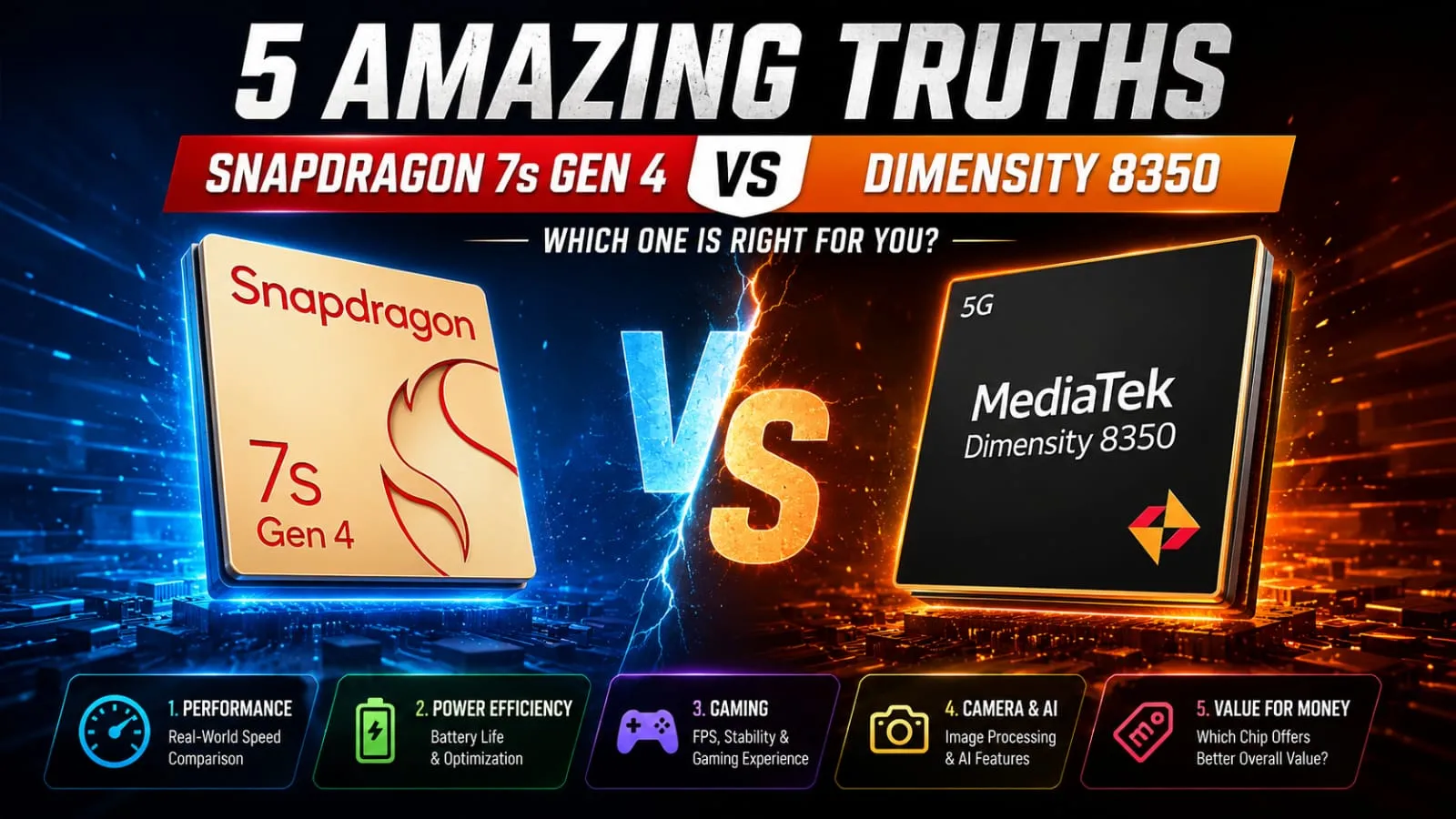
Snapdragon 7s Gen 4 vs Dimensity 8350: Benchmark, Score & Best Processor 2026

Snapdragon 7s Gen 4 vs Dimensity 8350 benchmark comparison

Introduction: Which chip is better for you, and which one should you choose? Tell me the truth, when you go to buy a new mid-range phone that’s within your budget, what do you look for first? Screen? Camera? Battery? Processor? All of these things matter, of course. But in 2026, the processor is the driving force behind your entire phone experience and is the most important part of the phone. And as of right now, two names are trending heavily in the mid-range market: the Snapdragon 7s Gen 4 vs Dimensity 8350. Both chips are built on 4nm. Both are designed for mid-range phones. Both are available in roughly the same price range. So, which one do you think will win? This article covers that in detail. Today, we’re doing a full benchmark comparison from AnTuTu scores, Geekbench 6, gaming, battery, and daily usage. You’ll find it all in this article. If you’re confused about which phone to buy, this article will help you make the right decision. Highlight key Just looking at this table, you can already tell that Dimensity 8350 is ahead. But numbers alone do not tell the whole story. Keep reading, there is a lot more to know! Feature Snapdragon 7s Gen 4 Dimensity 8350 Process Node 4nm 4nm Top Core Speed 2.7 GHz 3.35 GHz AnTuTu Score ~10,47,462 ~13,55,407 Geekbench Single-Core ~1,222 ~1,385 Geekbench Multi-Core ~3,145 ~4,310 GPU Adreno 810 Mali-G615 MC6 Wi-Fi Wi-Fi 6E Wi-Fi 6E Best For Battery life, value Gaming, performance Just looking at this table, you can already tell that Dimensity 8350 is ahead. But numbers alone do not tell the whole story. Keep reading, there is a lot more to know! Launch Date and Price: When Did They Come Out? Snapdragon 7s Gen 4 Launch Qualcomm officially announced the Snapdragon 7s Gen 4 on August 19, 2025. The first phone to use this chip was the Xiaomi Redmi Note 15 Pro+, which launched in China in August 2025. In India, you can find this chip in phones like the POCO M8 Pro and Infinix Note 60 Pro. The price range for phones with this chip is roughly ₹18,000 to ₹25,000. Dimensity 8350 Launch MediaTek announced the Dimensity 8350 on November 25, 2024. It is also built on a 4nm process. In India, you can find it in the OnePlus Nord CE5, which has been a very popular mid-range phone. Phones with this chip usually cost around ₹25,000 to ₹35,000. So there is a price difference, too. Snapdragon 7s Gen 4 phones are more affordable. Dimensity 8350 phones sit a little higher. Technical Specs: What Is Inside? CPU Cores and Speed The Snapdragon 7s Gen 4 has 8 cores: 1 main core running at 2.7 GHz, 3 performance cores at 2.4 GHz, and 4 small efficiency cores at 1.8 GHz. These are modern, power-saving cores. The Dimensity 8350 also has 8 cores: 1 main core at 3.35 GHz, 3 performance cores at 3.2 GHz, and 4 small cores at 2.2 GHz. Here is the big thing to notice — the Dimensity 8350’s main core runs at 3.35 GHz while the Snapdragon 7s Gen 4’s main core runs at only 2.7 GHz. That speed difference shows up in real life. Apps open faster, and everything feels snappier. In my experience, when I used a Dimensity 8350 phone, heavy apps and multiple open tabs ran very smoothly. On a Snapdragon 7s Gen 4 phone, there was a small lag when 12 to 15 apps were open in the background at the same time. GPU: Which One Is Better for Games? The Snapdragon 7s Gen 4 has the Adreno 810 GPU. The Dimensity 8350 has the Mali-G615 MC6 GPU. The GPU decides how smooth your games will run. We will talk more about this in the gaming section below. Also Read :  iPhone 17 Complete Information – Is It Worth Buying? AnTuTu Benchmark Score: Who Wins? iQOO Neo 10: Display, Design & Build Quality AnTuTu is a popular tool that checks the overall power of a processor, CPU, GPU, memory, and everything together in one score. Snapdragon 7s Gen 4 AnTuTu Score The Snapdragon 7s Gen 4 scored 10,47,462 points on AnTuTu, crossing the one million mark.  That is a solid number and puts it firmly in the upper mid-range category. To put this in context, this score is very close to chips like the Exynos 2100, Kirin 9000, and even the Snapdragon 888. So yes, old flagship-level performance is now available in mid-range phones — and that is genuinely impressive. Dimensity 8350 AnTuTu Score The Dimensity 8350 scored 13,55,407 points on AnTuTu. That is roughly 29% more than the Snapdragon 7s Gen 4. The Dimensity 8350 even outperforms the Snapdragon 8 Gen 1 and Exynos 2200, though it still falls a little short of the Snapdragon 8 Gen 2. That means this chip delivers near-flagship performance at a mid-range price. Pretty great, right? AnTuTu Winner: Dimensity 8350, not even a close fight here. Snapdragon 7s Gen 4 vs Dimensity 8350 Geekbench 6 Score AnTuTu gives you the full picture, but if you only want to test the CPU, Geekbench is the better tool. The single-core score tells you how fast apps open. The multi-core score tells you how the phone handles doing many things at the same time. Snapdragon 7s Gen 4 Geekbench Score On Geekbench 6, the Snapdragon 7s Gen 4 scored 1,222 points in single-core and 3,145 points in multi-core. The single-core score is decent app launch speed feels fine. Multi-core is where it falls a little behind. Dimensity 8350 Geekbench Score The Dimensity 8350 scored 1,385 in single-core and 4,310 in multi-core on Geekbench 6. Do the simple math, it is about 13% better in single-core and a massive 37% better in multi-core. That is a big gap, buddy. If you think as I do, multi-core score really matters when you have music playing, 10 tabs open in Chrome, and something downloading in the background all at the same … Read more