
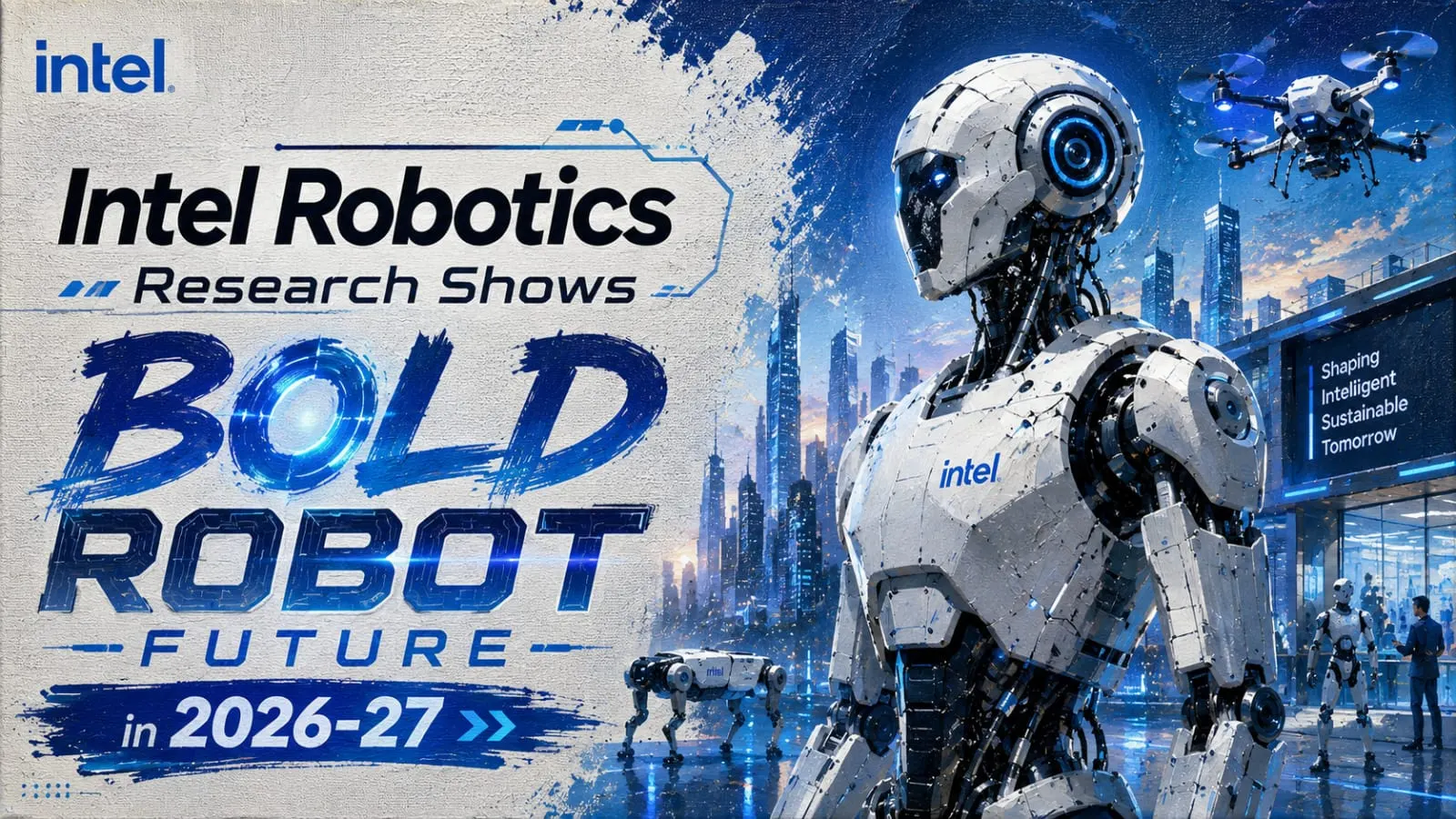
Buddy, have you also heard about Intel Robotics Research recently? If you work in technology or business, or just like reading about the future, this is really worth your time. Intel recently shared a big study, and it said something that could surprise you, as well as everyone else, or maybe not, if you already think robots are everywhere these days.
The short version? Six out of ten company leaders believe that in the next five years, their business will be run entirely by robots, not by humans. That’s a huge number, and it shows that robots are no longer just for factories. In my years of following tech news, I’ve hardly ever seen such a clear signal that a major change is coming this fast.
Let’s break it down in simple words, no complicated tech stuff, I promise you.
In This Article
ToggleHighlights
- Six in ten leaders expect robot fleets in their company within five years.
- Only four in ten actually have a real plan for humans and robots working together.
- Safety worries are slowing many companies down.
- Autonomous mobile robots are more popular than humanoid robots right now.
- Fast decision-making, under 100 milliseconds, is becoming a must-have
What Did the Intel Robotics Research Actually Find?
Intel did not just guess this stuff. They worked with research firms and talked to about 800 senior leaders across countries like the USA, UK, Germany, Japan, China, and South Korea. These were not small companies either; we are talking about businesses making over $500 million a year.
The Intel robotics research found that most leaders are excited about robots joining their teams. But here is the catch, buddy. Being excited is not the same as being ready. Only four in ten companies actually have a formal strategy to manage a mixed team of humans and robots. That is a big gap, and Intel is calling it the “robotics readiness gap.”
Tell me the truth, does your workplace even have a plan for robots yet? Most do not, and that is exactly the problem this study points out.
Six in Ten Leaders Plan Robot Fleets by 2030
This part is honestly the headline of the whole report. Two-thirds of leaders believe they will be ready to run a mixed human-robot workforce by 2030. That is not far away at all. If you think as I do, that timeline feels almost too close, especially for companies still figuring out basic automation.
Robots are moving from being a small test project to becoming a normal part of daily operations. Companies that already use robots are seeing real benefits too, like better productivity, better quality, and faster service. This is not hype; this is what the actual data shows.
Why Is There Such a Big Readiness Gap?
Good question, and Intel breaks it into a few clear reasons.
- Strategy problems: Many companies want robots but do not have a clear plan
- Skills shortage: Around four in ten companies say finding trained workers is hard
- Safety concerns: Almost half of companies already using robots reported safety incidents, and only about a third have proper global safety standards
- Infrastructure gaps: Robots need fast processing power close to where they work, not far-away servers
I once visited a small warehouse that added two robot arms without training anyone properly. It caused more confusion than help in the first few weeks. That small real-life example shows exactly why Intel is pushing companies to build a real strategy, not just buy robots and hope for the best.
Enterprise Robotics Adoption Is Growing Faster Than Expected
Enterprise robotics adoption is not slowing down; it is speeding up. Businesses are realizing that robots are not just for car factories anymore. Warehouses, hospitals, and even government offices are exploring robot fleets.
Interestingly, autonomous mobile robots, think of bigger, smarter versions of a robot vacuum, are far more popular than humanoid robots right now. Only about six percent of leaders think humanoid robots will make the biggest impact soon. So no, buddy, we are not getting robot butlers just yet. We are getting smart machines that move around warehouses and factories doing repetitive jobs.
How Fast Do Robots Need to Think?
Here is something cool. More than three-quarters of leaders say critical robot tasks need decisions made in under 100 milliseconds. That is faster than a blink. This is why edge computing, meaning processing data right where the robot works instead of sending it far away, is becoming so important.
This part of the robotics adoption story is honestly the most technical, but here is the simple version: robots need to think fast, and that speed cannot depend on slow internet connections.
Human-Robot Workforce Strategy, Why It Matters So Much
This is the heart of the whole report. A good human-robot workforce strategy is not just about buying machines. It is about training people, updating safety rules, and building systems that let humans and robots work side by side smoothly.
Companies that only add robots without changing their culture usually struggle. Companies that build a real plan tend to see robots double their output, according to the leaders surveyed. That is a strong number, but again, only if the planning happens first.
Is This Good News or Bad News?
Honestly, buddy, it is a mix of both.
The good news is robots are helping companies work faster and better. The bad news is most companies are simply not ready yet, and rushing into robotics without a plan can cause safety issues and wasted money.
If something is good, I will say it is good, and this trend genuinely looks promising for the next five years. But if something needs a warning, I will say that too, and the readiness gap is a real warning sign for many businesses in the USA and India.
Disclaimer: This article is based on publicly shared research and industry reports. It is just for general information and educational purposes. Please do your own research or definitely consult experts before making any business decisions related to adopting robotics.









FAQ's
What is Intel Robotics Research about?
It is a study showing that many companies expect to run robot fleets soon, but most still lack a proper plan for humans and robots working together.
How many companies plan to use robot fleets in five years?
About six out of ten senior leaders expect their organization to operate a robot fleet within the next five years, according to the research.
Why do companies struggle with robotics adoption?
Many face gaps in strategy, safety rules, and skilled workers, which makes scaling robots harder even when leaders are excited about using them.
Are humanoid robots the most popular choice?
No, autonomous mobile robots are far more popular right now, while humanoid robots are expected to have a smaller impact in the near future.
Why is fast decision making important for robots?
Many robot tasks need responses in under 100 milliseconds, so processing happens near the robot instead of relying on distant servers.

Deepak Kumar is the founder and author of Techallrounder.com. He covers the latest technology news, smartphone and laptop reviews, gadget comparisons, buying guides, and tech tips. His goal is to provide accurate, easy-to-understand, and up-to-date information that helps readers make better technology decisions.