
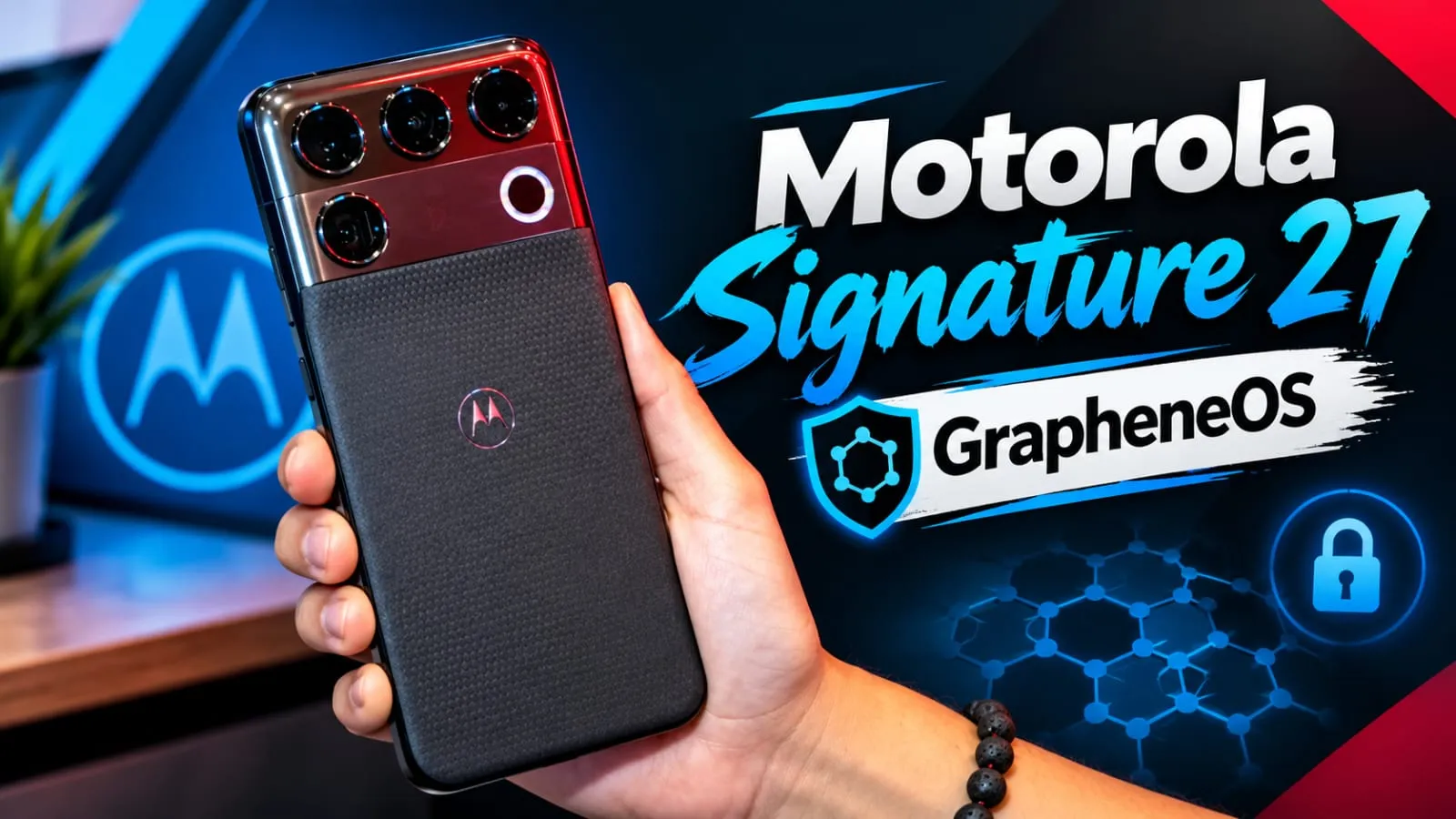
Hey friend, if you’re worried about your smartphone’s privacy, this news is really going to be big. For years, if you wanted to use GrapheneOS, you basically only had one option, and that was Google Pixel. Now, this situation finally seems to be changing, because Motorola Signature 27 GrapheneOS support has now been officially confirmed.
In my experience, privacy-focused users often feel pretty stuck when choosing hardware, because strong privacy software usually meant limited phone options. This announcement really breaks that pattern for the first time.
In This Article
ToggleWhat Exactly Was Announced About Motorola Signature 27 GrapheneOS Support?
Let’s get straight to the point, buddy.
Following this week’s unveiling of the phone at the Qualcomm Snapdragon Tech Summit, GrapheneOS officially confirmed that the Motorola Signature 27 will be its first supported Motorola device. This confirmation came directly from GrapheneOS’s own account, responding to a user question about whether the Signature 27 would run the software.
Tell me the truth: this is a genuinely big deal, since GrapheneOS has stuck exclusively to Pixel phones for years, mainly because most other Android phones simply did not meet its strict hardware requirements.
Why Did GrapheneOS Choose Motorola Signature 27 First?
Now let’s talk about the “why” behind this decision.
GrapheneOS has always been picky about hardware, and for good reason. The project requires things like an unlockable bootloader, hardware memory tagging, strong secure element integration, and a genuine commitment to long-term software updates.
The Motorola Signature 27 checks these boxes comfortably. It runs on Qualcomm’s brand-new Snapdragon 8 Elite Extreme Gen 6 chipset, built on a 2nm process. Alongside that, Motorola has promised seven major OS upgrades and up to seven years of security updates, which genuinely matches what GrapheneOS demands from its supported devices.
If you think as I do, this partnership makes perfect sense, since GrapheneOS previously explained that only Qualcomm’s top-tier flagship chips currently offer the security features needed for proper support.
Motorola Signature 27 Privacy Features – What Changes With GrapheneOS?
This is honestly the most important part for privacy-focused buyers.
GrapheneOS is built on top of the Android Open Source Project, but it strips away Google’s default tracking and telemetry. Once installed, the phone does not come with Google Mobile Services by default, though it can still run regular Android apps.
Here is what makes this genuinely appealing:
- Reduced tracking from apps and websites
- Optional, sandboxed access to Google Play services, only if you choose to enable it
- Stronger app permission controls compared to standard Android.
- Ability to block network access individually for each app
In my experience, that last feature alone is genuinely powerful, since it lets you stop specific apps from silently sending data in the background, something regular Android does not easily allow.
Motorola Signature 27 First Non-Pixel GrapheneOS Phone – Why Does This Matter?
Buddy, this title alone tells you how significant this moment is.
Since its inception, GrapheneOS has remained tightly anchored to Google’s Pixel lineup, mainly because Pixel phones offered predictable security components like the Titan M2 chip and reliable long-term firmware support. Now, for the very first time, privacy-focused users get a genuine alternative outside Google’s own hardware ecosystem.
This partnership between Motorola and GrapheneOS was actually announced earlier this year, back in March 2026, though the specific supported model remained unknown until this week’s Signature 27 unveiling finally answered that question.
What Are the Motorola Signature 27 Specifications Besides GrapheneOS?
Now let’s talk about the phone itself, since good software still needs solid hardware to shine.
- Processor: Snapdragon 8 Elite Extreme Gen 6, built on TSMC’s 2nm process
- Camera: 200MP periscope telephoto lens paired with an updated 50MP main sensor
- Audio: Bang & Olufsen-tuned sound system
- Software Support: Seven OS upgrades and up to seven years of security patches
Tell me the truth, this hardware genuinely sounds flagship-worthy, even before factoring in the GrapheneOS privacy angle.
When Will Motorola Signature 27 Actually Launch?
Here comes the part where I have to be honest, buddy, since not everything is confirmed yet.
Motorola has not announced an exact release date or pricing for the Signature 27. The company’s North American product page currently mentions a November arrival, without specifying an exact day. Since pricing remains unannounced, it is currently difficult to directly compare this phone against existing GrapheneOS-supported Pixel models.
In my experience, waiting a little longer for official pricing details is genuinely worth it before making any purchase decisions here.
How GrapheneOS Will Work on Motorola Signature 27 Going Forward
Interestingly, this rollout does not stop at just one phone.
GrapheneOS has mentioned that Motorola’s foldable devices, specifically future Razr Fold and Razr Ultra models, came close to qualifying for support as well, and are expected to join later. The team has also expressed interest in eventually supporting more affordable Motorola devices, though that depends on Qualcomm extending stronger security features to non-flagship chipsets too.
If you think like I do, starting with a high-end flagship first makes complete sense, since it lets GrapheneOS thoroughly test compatibility before expanding to a wider range of devices.
Should Privacy-Focused Buyers Get Excited About This?
Honestly, buddy, yes, but with a little patience.
This announcement genuinely gives privacy-conscious users a real alternative to Pixel phones for the first time in years. However, since pricing and the exact launch date remain unclear, it is still too early to fully commit until more official details arrive.
Final Thoughts on Motorola Signature 27 GrapheneOS
To sum it up, the Motorola Signature 27 GrapheneOS partnership marks a genuinely historic shift for privacy-focused Android users. For the first time, strong hardware and hardened privacy software are no longer limited to Google’s own devices. It is not a perfect launch yet, since pricing and exact availability are still pending, but the direction here is genuinely exciting.
Now let’s talk about you. Would you consider switching to a non-Pixel phone just to get GrapheneOS, or are you waiting for more details before deciding?
Disclaimer: This article is based on publicly available information at the time of writing. Release dates, pricing, and software rollout details may change. Please check Motorola’s official website or GrapheneOS’s official channels for the latest and most accurate updates.


FAQ's
Is Motorola Signature 27 the first non-Pixel phone to support GrapheneOS?
Yes, it is officially confirmed as the first Motorola device and the first non-Pixel phone to receive GrapheneOS support.
When will Motorola Signature 27 launch?
Motorola has only confirmed a November arrival for North America, without revealing an exact release date or pricing yet.
What chipset powers the Motorola Signature 27?
It runs on Qualcomm’s Snapdragon 8 Elite Extreme Gen 6 chipset, built using TSMC’s advanced 2nm manufacturing process.
Does GrapheneOS remove Google services completely?
By default, Google Mobile Services are not included, though users can optionally enable sandboxed Google Play services if needed.
Will other Motorola phones support GrapheneOS in the future?
Yes, future Razr Fold and Razr Ultra foldables are expected to gain support, along with select affordable models later.

Samshul Ansari is the Co-founder and author of Techallrounder.com. He covers the latest technology news, smartphone and laptop reviews, gadget comparisons, buying guides, and tech tips. His goal is to provide accurate, easy-to-understand, and up-to-date information that helps readers make better technology decisions.