
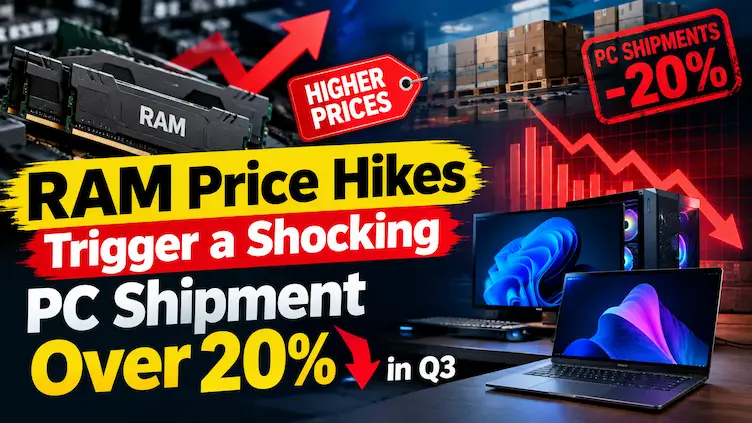
RAM price hikes have pushed the whole PC market into a tough spot, and the Q3 numbers show it clearly. Recently, seeing this, you must have also wondered how this actually happened, right? You’re not alone. According to IDC’s preliminary estimates, the global PC market saw a big drop between July and September 2026. During this period, PC shipments fell 20.1% year-on-year, limited to 62.7 million units. In this article, I’ll explain why this happened, who got hit the hardest, and what it means for you in the US and India.
In This Article
ToggleHighlights
Global PC shipments fell 20.1% year over year in Q3 2026, says IDC.
There was a difference in the figures from the two research firms. Omdia reported a 21.2% drop, while Gartner reported a 22.4% decline.
RAM price hikes and costly storage pushed PC prices up.
AI data centers are taking a big share of memory chips.
Early stockpiling made the Q3 fall look even sharper.
IDC expects the memory shortage to last at least until the end of 2027.
How did PC shipments perform during the third quarter of 2026?
Let’s start with the basic numbers. IDC says 62.7 million PCs shipped in Q3, down from 78.5 million a year earlier. That is also 9.1% lower than Q2. Normally, the third quarter gets a lift from back-to-school shopping. This time, that lift never came.
Other firms saw the same thing. According to the Omdia report, there was a 21.2 percent decrease. Gartner reported 55.4 million units, a 22.4 per cent fall. The numbers differ because each firm counts in its own way. However, the story is the same everywhere. The PC shipments decline is real, and RAM price hikes are a big reason.
One small note. The shipment numbers don’t show that the same number of products were sold to customers. Shipments show what companies send to stores and distributors, so they do not exactly show what people bought. Still, they tell us where the PC market slowdown is heading.
Why Are RAM Price Hikes Hurting the PC Market So Much?
Here is the simple answer. RAM is a must-have part in every computer. When its price jumps, the cost of building a laptop or desktop jumps too. Gartner said DRAM costs rose five times year over year in Q2, and PC makers passed those costs on to buyers. How is the jump in RAM prices affecting the PC market supply?
Now, RAM is a smaller part of a PC than the processor or the screen. However, a huge price jump still changes the total bill, mainly in models with 32GB, 64GB, or more. One report even mentioned a 128GB DDR5 kit costing up to $3,399.
AI data centers also need the same type of memory.
Why is memory so costly? Because AI companies are building giant data centers. They need top-quality memory and fast storage, and they are ready to pay more. Chip factories therefore shift their effort to those orders, and regular PC makers must fight for what is left. In my experience, when a rich buyer enters a small market, normal buyers always lose.
Stockpiling Made Q3 Look Worse
There is another side to this story. Vendors and channels increased orders in the first half of 2026 because they expected RAM and storage prices to rise further. Shipments went up 3.2% in Q1, then fell just 4% in Q2. By Q3, that rush was over, so part of the 20% drop is a hangover.
However, experts do not fully agree. IDC talks about sellers fearing extra stock. Gartner says the fall came mostly from higher prices and makers choosing where to use scarce parts, not from extra stock. Both views lead back to RAM price hikes.
Which PC Brands Took the Biggest Hit?
Lenovo stayed number one with 14.9 million PCs and a 23.8% share. HP came second with 10.3 million, then Dell with 7.6 million, and Apple with 5.9 million. Lenovo, HP, and Dell all declined faster than the overall market.
HP had the worst number in IDC’s data, with a 30.9% drop. Apple fell 11.3%, which is smaller. If you think as I do, this shows that brands selling many budget and mid-range laptops feel the pain first. Cheap models have thin profit margins, so they cannot easily absorb costly memory.
How does expensive RAM in the US and India affect PC prices?
Let me be honest. Nobody has a perfect price forecast for each country. But the direction is clear. In February, Gartner projected a 17% rise in PC prices and the disappearance of models under $500 by 2028. That is a forecast, not a promise, but it shows the worry.
What US Buyers May See
In the USA, shoppers wait for sales like Black Friday. This year, deals on RAM-heavy laptops may be smaller. IDC’s Jitesh Ubrani said promotions and short-term relief could come, but prices will stay elevated. Gamers and creators who need 32GB or more may feel it most.
What Indian Buyers May See
In India, many people buy a laptop for study or work and watch the budget closely. I once helped a cousin pick a college laptop, and a few thousand rupees decided everything. Amid rising RAM prices, people might find it better to wait a bit before buying a new device, go for an older device, or choose a variant with less space. Reports do not give an Indian price series yet, so watch local store prices closely.
What Does This Mean for Laptop Makers and Sellers?
For makers, it is a hard balance. If they raise prices, fewer people buy. If they keep prices low, profit shrinks. For this reason, many companies are now promoting premium smartphones, because it’s easier to fit the rising cost of memory within the price.
Sellers have a different headache. They stocked up early, and now high prices are keeping buyers away. A friend who runs a small computer shop told me customers now ask for a price and then walk away to think. This gives an idea of how the PC market decline is affecting businesses and customers.
Should I buy a new computer now or wait for better options?
Tell me the truth: the answer depends on your needs. Here is a simple guide:
- Buy now if your PC is slow or broken, and you use it for work or study.
- Wait a little if your PC still works fine. Holiday and festive sales may bring small discounts.
- Choose smart specs. 16GB RAM is enough for most daily users, so do not pay extra for 64GB if you never need it.
- Check upgrade options. Some laptops let you add RAM later, but many thin models do not.
The good news is that stores may cut prices to clear stock. The bad news is that you should not expect last year’s prices.
Will RAM Price Hikes End in 2027?
Probably not soon. IDC points to the memory shortage lasting at least until the end of 2027. IDC also warned that the outlook may get worse before it gets better. Looking at these conditions, it might take a bit more time for the PC market to improve.
There is one small hope. When buyers stop buying, memory makers often feel the pressure and may adjust. But that is my opinion, not a fact.
Final Thoughts on RAM Price Hikes and the PC Market
In short, the main reason behind this sharp drop of over 20% in Q3 2026 is the increase in RAM prices. AI demand, expensive storage, and the rush to stock up have all made the problem worse. The best plan for you is simple. Only buy what you need, compare prices, and avoid rushing into purchases in a panic.
Disclaimer: This article is for general information only. Figures come from preliminary reports by IDC, Omdia, and Gartner and may change. Prices and forecasts can shift, so please check official sources and local stores before you buy.










FAQ's
Why did PC shipments drop in Q3 2026?
Costlier memory and storage pushed laptop prices up, buyers held back, and earlier stockpiling faded. IDC counted a 20.1% yearly fall to 62.7 million PCs worldwide.
What are RAM price hikes?
RAM price hikes mean memory chips cost much more than before. PC makers pay extra for every device, so they raise prices or ship fewer units.
How much did PC shipments fall in Q3?
IDC says 20.1%, Omdia says 21.2%, and Gartner says 22.4%. The numbers differ a little because each firm tracks the market in its own way.
Why is RAM so expensive right now?
AI data centers are buying huge amounts of memory and storage. Chip makers focus on those big orders, so less supply is left for regular PCs.
Will laptop prices go down in 2027?
Not by much. IDC expects prices to stay well above last year’s level and says the memory shortage may last at least until the end of 2027.

Deepak Kumar is the founder and author of Techallrounder.com. He covers the latest technology news, smartphone and laptop reviews, gadget comparisons, buying guides, and tech tips. His goal is to provide accurate, easy-to-understand, and up-to-date information that helps readers make better technology decisions.