Tech all rounder

Redmi Turbo 5: Shocking Power Beast phone of 2026
Redmi Turbo 5: Shocking Power Beast phone of 2026

Friends, are you also troubled by mobile battery problems? Are you also, like me, fully charging your phone every morning and by evening only having 20-30% left? I was also facing the same situation until I properly looked at the specifications of the Redmi Turbo 5. This phone is truly a battery monster that is going to make a lot of noise in the mid-range category. It was launched in the Chinese markets in January 2026, and now it is also preparing to make a splash in India – it is estimated that you may be able to see it as an Amazon exclusive around June 2026. I am a regular tech blogger (Techallrounder.com) who personally tries out every new phone (or analyzes it after reading reviews). This time, the Turbo 5 has won my heart. Let’s find out all the information about it in this article today. Highlight key Battery: 7560mAh (sabse badi highlight) – lasts 1.5 to 2 days Processor: Dimensity 8500 Ultra – smooth gaming & multitasking Charging: 100W fast (45 min full) + 27W reverse Display: 6.59-inch 1.5K 120Hz AMOLED, 3500 nits brightness Build: 8.2mm slim, IP68 + IP69K rating. Camera: 50MP main (daylight accurate, low-light average) Price in India: ₹33,000 – ₹45,000 expected Redmi Turbo 5 Price in India and Launch Details The starting price in China was around CNY 1999 (roughly ₹28,000). In India, the expected price is between ₹33,000 and ₹45,000, depending on the variant (12GB+256GB or 16GB+512GB). An Amazon exclusive launch may happen in June 2026. The variants available will be 12/256GB and 16/512GB options. Compared to competitors like the Poco X series or Realme GT, it seems ahead in terms of battery and performance. Redmi Turbo 5 Design and Build Quality First impression wins the game, right? Looking at the design of Redmi Turbo 5, it feels like it’s giving a flagship vibe. The thickness is just 8.2mm, and the weight is around 204 grams. It feels completely comfortable in the hand, not heavy despite such a big battery. The company has used advanced silicon-carbon battery technology, which they have named ‘Xiaomi Jinsha River Battery.’ The energy density is very high, which is why it fits into such a compact size. The back panel has 2.5D glass and a metal frame, which gives a premium touch. The colors are also stylish, especially the matte-finish ones that hide fingerprints. The biggest thing – IP68 + IP69K rating. This means it is dustproof and can also withstand high-pressure water jets. You can use it without worry in the rain or on construction sites. A friend of mine had his phone damaged by water, and seeing this, he said, ‘Bro, I will get this one. Also Read: OPPO Reno 16 Pro Mini: Powerful Compact Flagship 2026 Display – 6.59-inch 1.5K AMOLED that will shine even in sunlight You’ll enjoy watching the screen. The Redmi Turbo 5 has a 6.59-inch 1.5K AMOLED panel with a 120Hz refresh rate. The resolution is 1268 x 2756 pixels – providing sharp visuals. The peak brightness goes up to 3500 nits, so it will be clearly visible even in Delhi heat or Varanasi sunlight. It supports Dolby Vision and HDR10+, giving a different experience for movies and YouTube. It also has 3840Hz PWM dimming, which provides comfort to the eyes at low brightness. You won’t feel tired while scrolling reels at night. Corning Gorilla Glass protection is also provided. Overall, in this price segment, this display is a very strong point. Camera Setup – Is It Decent or Average? I’ll be straightforward – Redmi Turbo 5 is not a camera-centric phone. 50MP Sony IMX882 main sensor with OIS, f/1.5 aperture – takes good photos in daylight, colors are natural, details are sharp. Struggles a bit in low light, but it’s manageable.There are 8MP ultra-wide + macro modes. Video can be recorded at up to 4K 60fps. The front has a 20MP selfie camera, which is sufficient for normal use. If you do vlogging or pro photography, look for better options; otherwise, this is perfectly fine for daily clicks. Performance: The Real Power of Dimensity 8500 Ultra Now let’s talk about the real hero. MediaTek Dimensity 8500 Ultra (4nm) – Redmi Turbo 5 is the first phone to come with this chipset. Octa-core processor with a max 3.4GHz clock speed. Multitasking is butter smooth with LPDDR5X Ultra RAM (up to 16GB) and UFS 4.1 storage. What happens in real life? You can play BGMI, COD Mobile, and Genshin Impact – all on high settings. It has a 3D Ice-Sealed Circulation Cooling system, which provides 3x better heat dissipation than traditional VC cooling. Even after heavy gaming sessions, the phone doesn’t get too hot. I saw in reviews that it remained very stable in sustained performance.   Geekbench scores are also impressive. In daily use, apps stay in the background, and switching is fast. HyperOS 3 is based on Android 16 – not completely clean (there is a little of Redmi’s signature bloatware), but very customizable. Gestures, themes, everything is smooth. Battery Life – The True Monster of 7560mAh This section is the most important. 7560mAh silicon-carbon battery – nowadays, this is the biggest selling point in phones. In real-world usage:  Normal use (social media, calls, YouTube): easily 2 days Heavy use (gaming + video): comfortably even 1 day Standby time is on the next level With 100W fast charging, it gets fully charged in under 45 minutes. Redmi Turbo 5 also has 27W reverse charging – so if your friend’s phone is low, you can help. It supports the PPS protocol as well, which provides fast charging with compatible chargers. I remember when I was in college, I used to carry a power bank with me. Seeing this phone today, it feels like the need for a power bank is gone. Perfect for people looking for phones with long battery life. Other Features That You Will Like Stereo speakers with good loudness In-display fingerprint sensor – fast open and reliable IR blaster – can control … Read more

Sony Xperia 1 VIII Review: Is This the Most Unique Flagship of 2026? Honest Opinion

Sony Xperia 1 VIII: Serious Problems Nobody Mentions

Friends, if you are among those users who find modern smartphones almost the same these days – the same punch-hole camera, unnecessarily super-fast charging, curved screen, and excessively shiny colors – then Sony’s new smartphone can captivate your mind. The Sony Xperia 1 VIII finally launched in Japan on May 13, 2026. It will soon be available for users in the Indian market. This time, the company has made some new changes to the phone’s look, but some classic features that have become its identity are still visible in it. I am sharing this experience from Shaktinagar, and my friend has been using it in his daily life for the past few days. I received the review unit from my Japanese friend, so this opinion is entirely based on my real experience. Now, let’s find out how powerful this phone proves to be in actual use. Highlight key Naya Square Camera Design with premium ORE finish 6.5″ LTPO OLED 120Hz display – bright & natural 48MP Triple Camera + powerful Telephoto (best upgrade) Snapdragon 8 Elite Gen 5 + up to 16GB RAM 5000mAh battery – lasts 1.5 to 2 days 3.5mm Headphone Jack + microSD slot (up to 1TB) Dedicated shutter button & clean Android 16 IP68 rating + solid premium build Price and Availability – How Expensive Is It? Starting price €1,499 / £1,399 (12GB + 256GB), which can cost around ₹1.4 to1.6 lakh in the grey market in India. 16GB + 1TB version approx €1,999 / £1,849. Free WH-1000XM6 headphones are available for pre-order. The official launch in India will have to wait a bit, coming first in Europe and Japan. Not coming to the US. Sony Xperia 1 VIII Design and Build Quality – Old Sony + Fresh Look Earlier, the Xperia 1 series had that long vertical camera strip, which became a signature. Now, the Xperia 1 VIII has a square camera island, which feels a bit like the Google Pixel but with Sony’s own twist. The back has an “ORE” texture finish – it is matte and grippy and looks very premium in the light. Fingerprints don’t stick, which is a big relief in daily life. Phone dimensions are approximately 162 x 74 x 8.3mm, and the weight is around 200g. It feels solid in the hand, not slippery. Symmetrical bezels are still there – top and bottom are a bit larger to accommodate the front-firing stereo speakers. No notch or punch hole; the whole screen is clean. There is also a dedicated camera shutter button on the side, which is a godsend for real photographers. I tried the Garnet Red color – people in the office kept asking, “Bro, what new thing have you brought?” Colors available are Graphite Black, Iolite Silver, Garnet Red, and Native Gold (1TB version). Build quality is top class – IP65/IP68 rating, Gorilla Glass protection. This phone feels like the company thought, “We don’t want to be like everyone else.” If you are searching for ‘Sony Xperia 1 VIII design review India,’ let me tell you, this is perfect for those who like compact, tall phones that can be handled well with one hand. Also Read: iQOO Z11 Review: Shocking Features You Can’t Ignore in 2026 Display – Bright, Smooth, and Practical 6.5-inch LTPO OLED display, 120Hz refresh rate, HDR support, 1 billion colours. Resolution is FHD+ (1080×2340). Many people ask for 4K, but in real life, this resolution saves battery, and the difference is not that noticeable in normal usage.   Brightness is good – readable even in direct Varanasi sunlight. Colores appear natural, watching movies is fun. The refresh rate adjusts dynamically due to LTPO technology, hence saving battery. It is a flat screen, not curved, which I personally like, as accidental touches are reduced. Camera System – This is the Real Star! Sony has focused the most on the camera this time. Triple 48MP setup: Main sensor (f/1.9) Ultrawide (f/2.0) Telephoto – this is a game changer! New 1/1.56-inch sensor which is almost 4 times larger than the previous one, 70mm focal length (roughly 2.9x optical zoom). All rear cameras support RAW multi-frame processing. Details and colours are much better in low light. The AI Camera Assistant feature is new – like a personal photography guru. It recognizes scenes, gives suggestions about settings, and suggests bokeh effects. It’s helpful for beginners and an extra tool for pros. I shot at the Ganga ghat – lights, reflections, people’s faces. Even zooming with the telephoto, the clarity was good. Colores are not over-processed; it’s a natural Sony signature. Video recording is also solid with good stabilization. If you search for “best camera phone for photography lovers 2026” or “Sony Xperia 1 VIII telephoto review,” this phone will appear in the list. Performance, Software, and Battery Life Under the hood, Snapdragon 8 Elite Gen 5 chipset, 12GB/16GB RAM options, and storage from 256GB to 1TB (expandable via microSD – yes, still!). Multitasking, gaming (Genshin, COD), video editing – all smooth. Heat management is good; it gets a little hot during heavy use, but it’s manageable.   Android 16 out of the box, clean experience with minimal bloatware. Sony is promising 4 major OS updates + 6 years of security. Features like Side Sense and Game Enhancer are there.   5000mAh battery – Sony claims it lasts up to 2 days. With my heavy use (camera + streaming + social), it comfortably lasted one day. With normal use, 1.5-2 days is possible. 30W wired charging feels a bit slow by today’s standards, but 15W wireless is also available. Unique Features That Make Sony Different   3.5mm headphone jack – Even in 2026! A blessing for music lovers. microSD card slot – You can expand more than 1TB. Front-firing stereo speakers with good bass. Dedicated shutter key and pro camera controls. USB video output support. These features are becoming extinct these days, but Sony still provides them. Sony Xperia 1 VIII Pros and Cons      Pros: Unique design and premium build Excellent natural camera, … Read more

Honor Pad 20 Full Review: The Most Confusing Tablet Ever?

Honor Pad 20 premium tablet feature image with 12.1-inch display and stylish design

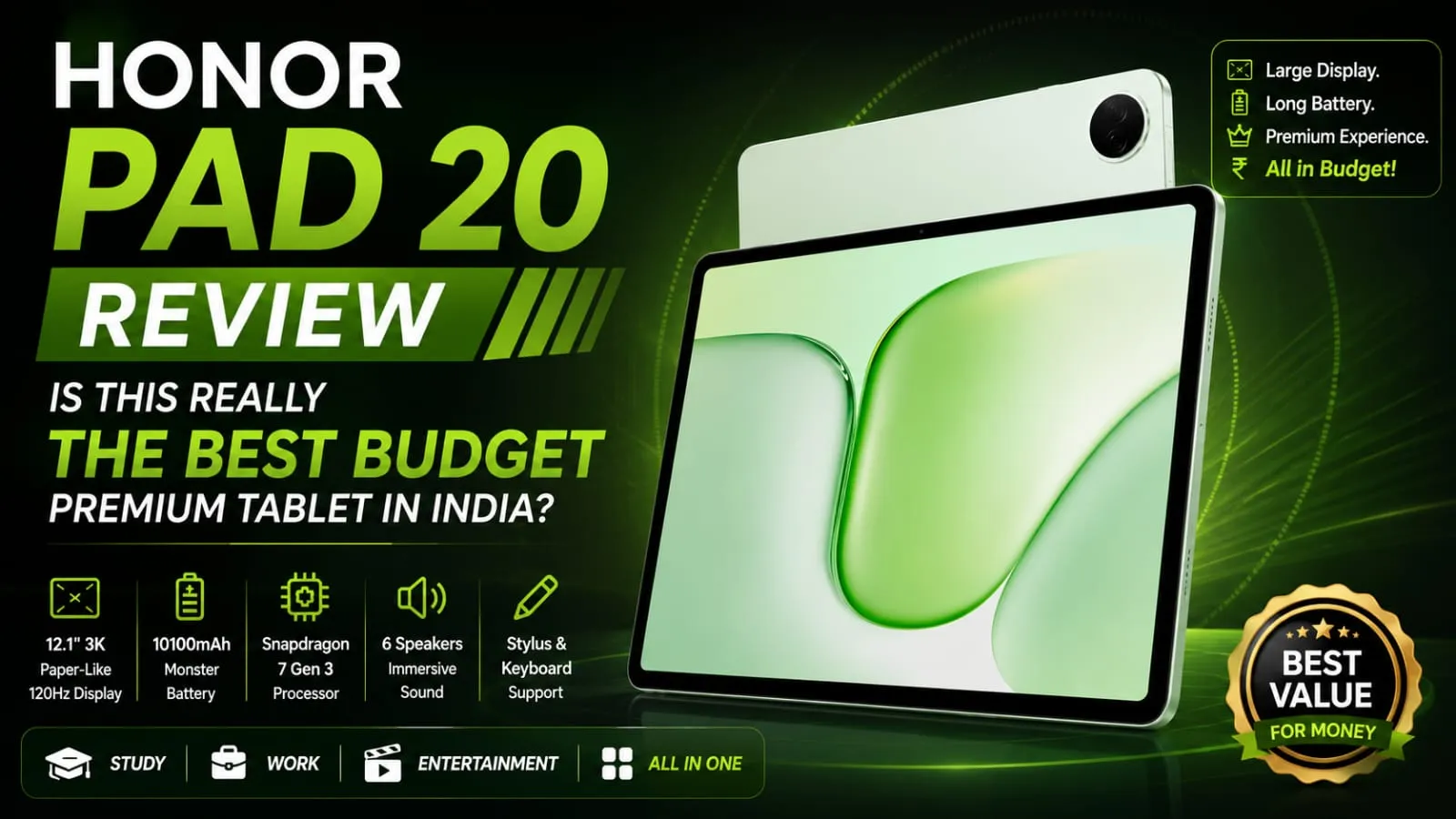
Hi friends, are you also considering a tablet this year? Looking for a premium feel, a large screen, a stylus-based note-taking experience, and a long-lasting battery life on a budget? The Honor Pad 20 has made waves since its launch. I’ve used it myself (by importing the Chinese version), and now I’m writing a full, detailed review to help clear up any confusion. This article is lengthy because I want to cover all details – from design to real-life usage. Whether you’re a student, a working professional, or looking for a tablet for home entertainment, be sure to read to the end. Let’s get started! Highlight key 12.1-inch 3K Paper-Like Display + 120Hz 10,100mAh Monster Battery (lasts 1.5 days) Snapdragon 7 Gen 3 + 8GB RAM – smooth multitasking Premium metal body + slim design 6 Powerful Speakers – amazing sound Stylus & Keyboard support Expected Price in India: ₹23,000 – ₹29,000 Best For: Students, notes, online classes & entertainmentNot For: Heavy gaming & pro editing.Verdict: Best premium-feel tablet in the budget! Honor Pad 20 Price in India and Value for Money Now, the most important – the expected price of the Honor Pad 20 in India could be around ₹22,990 to ₹28,999 (depending on the variant). It has recently launched in China and is coming to India soon. Getting such a large paper-like display, a monster battery, and solid performance at this price is very rare. Compared to the Samsung Galaxy Tab S9 FE or similar models from Lenovo, Honor leads in value. It will become a strong contender in searches like ‘best budget tablet for students with stylus support India 2026’ or ‘Honor Pad 20 vs iPad 10th gen comparison’. Honor Pad 20 Specifications Category Details Display Size 12.1-inch Display Type LCD Display, 3K Resolution, 120Hz Processor Qualcomm Snapdragon 7 Gen 3 Operating System Android 16 UI MagicOS 10 RAM/Storage 8GB / 12GB, 128GB / 256GB Rear Camera 8MP Front Camera 8MP Battery 10,100mAh Fast Charging 45W Fast Charging Connectivity Wi-Fi, Bluetooth, USB Type-C AI Features AI Learning & Productivity Tools Colors White, Gray, Blue Expected India Launch June or July 2026 Price (India) Around ₹30,000 – ₹35,000 Also Read: iQOO Z11 Review: Shocking Features You Can’t Ignore in 2026 Honor Pad 20 Unboxing and First Impression When I opened the box, the first thing that caught my eye was that slim and elegant tablet. I got the grey color variant, and it looked completely premium. The Honor Pad 20 has a 12.1-inch 3K paper-like display, which gives a completely different feel. When I held it for the first time, it felt like I was holding a costly flagship tablet. The build quality is solid – metal unibody, slim bezels, and not too heavy either (it would be around 550-580g).Compared to my old iPad, this feels a bit bigger and more productive. If you enjoy watching movies on a big screen, reading PDFs, and using split-screen, this will impress you. Design and Build Quality – Premium Look on Budget Honor didn’t compromise on design this time around. The matte finish back panel keeps fingerprints at bay, which is very useful in daily use.The edges are rounded, so it feels comfortable in the hand. The colours available are Grey, Forest Green, and Vibrant Pink. I would personally recommend Grey because it gives a professional look. The thickness is very low, so it fits easily in a bag. But yes, a small thing – since this is a full metal body, it can be a bit slippery without a case. I suggest getting a good-quality case.Overall, in the ₹20-30k segment, its design and build quality are top class. Many competitors provide a plastic body, but Honor has put in extra effort here. Display Quality – Paper-Like Magic That Will Win Hearts Design and Build Quality – Premium Look on Budget Now the real hero – 12.1-inch 3K ‘full color paper-like’ LCD screen. The resolution is around 1600×2560 pixels, supports a 120Hz refresh rate, and the 16:10 aspect ratio is perfect for productivity. Honor has given a specially textured coating that provides the friction of real paper when writing with a stylus. I took notes for a full day – the writing feel was amazing. No lag, smooth strokes, and very little eye strain. A Soft Light version is also available that reduces glare. This feature is a godsend for long reading sessions (like exam preparation). Brightness is good, colors are vibrant, and HDR content looks great on Netflix. I remember how my eyes would start to hurt after a while on normal glossy screens during college. This tablet was comfortable even after 4-5 hours of continuous reading. If you’re searching for “best display budget tablet India,” this one will be on top of the list. Performance and Software – How Smooth Are Daily Tasks? Performance and Software – How Smooth Are Daily Tasks? Under the hood is a Snapdragon 7 Gen 3 chipset with 8GB of RAM and 128GB/256GB of storage options.How does it perform in real life? Multitasking: 15 tabs + Notion + WhatsApp + YouTube background in Chrome – everything runs smoothly. Light gaming: COD Mobile is smooth on medium-high settings, a little hot in long sessions, but playable. Productivity: PDF editing, Microsoft Office, note-taking apps – no complaints. MagicOS 10 (based on Android 16) gives a clean experience. Bloatware is minimal, and AI features like smart note summarization, voice-to-text, and quiz generator are very helpful for students. Yes, it is not the best for heavy video editing or pro-level gaming. But for 90% of users’ daily needs – online classes, office work, content consumption – it is more than enough.A personal experience: I binge-watched a full movie series on it, and it never hung. Minor stutters occur only when you push the RAM to its full limit. Battery Life – The Real Power of Monster 10100mAh Battery Life – The Real Power of Monster 10100mAh This is my favorite section! 10,100mAh battery with 45W fast charging.On a normal day, 3-4 hours screen on (browsing + … Read more

OPPO Reno 16 Pro Mini: Powerful Compact Flagship 2026

OPPO Reno 16 Pro Mini: Compact Flagship Phone 2026

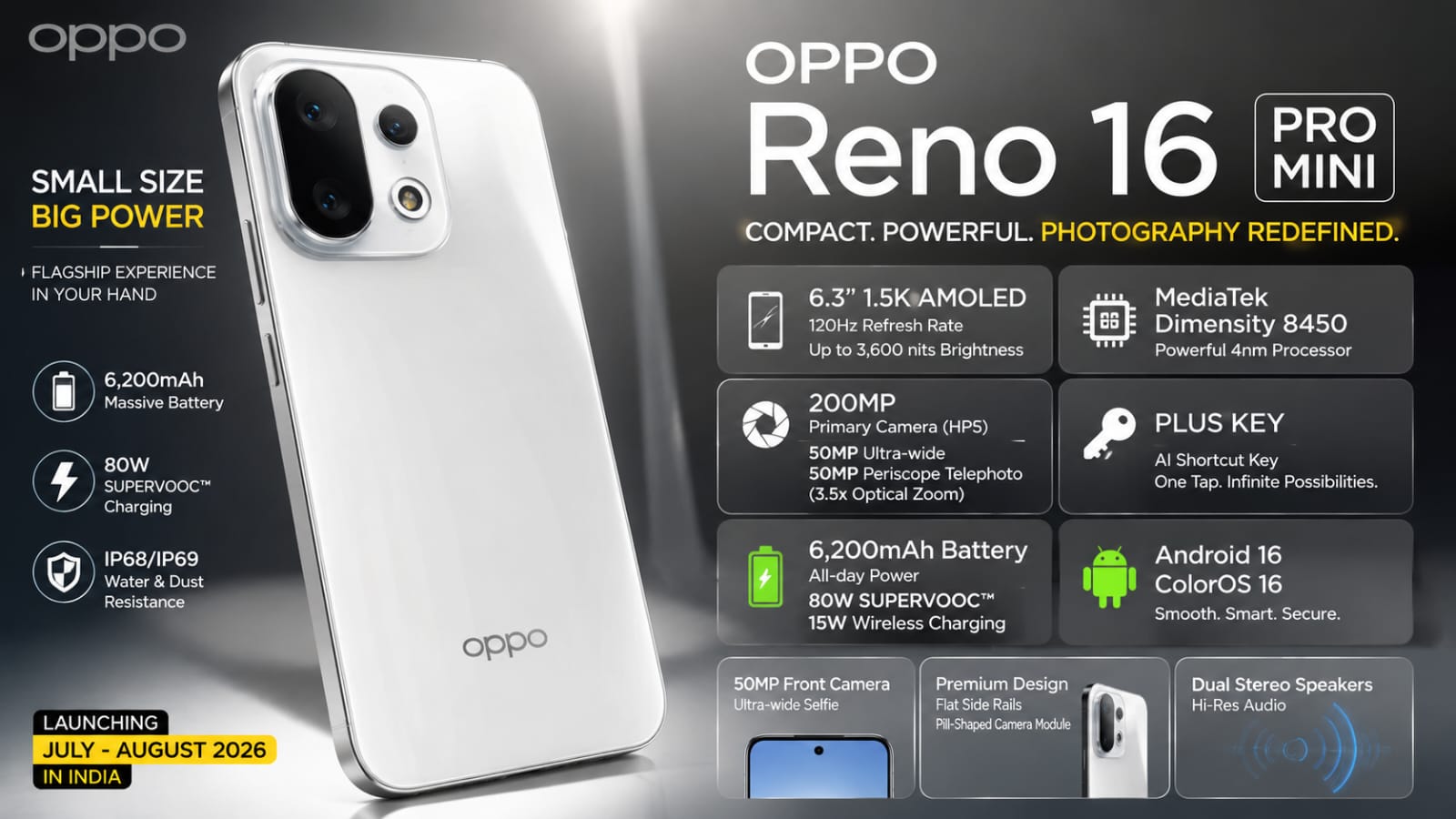
Hey buddy, are you tired of huge, bulky phones that barely fit in your pocket? I feel you. Last month, I tried using a friend’s massive phablet, and honestly, I almost dropped it three times just trying to text back. That’s exactly why I’m excited about the upcoming OPPO Reno 16 Pro Mini. Word on the street is that OPPO is doubling down on compact flagships, and this little beast might just be the perfect balance of power and portability. In this article, we’ll break down everything you need to know – from the expected OPPO Reno 16 Pro Mini launch date in India to the rumored price, full specifications, camera quality, battery details, and whether it’s actually worth your hard-earned money in 2026. So grab a coffee, and let’s chat like two friends geeking out over phones. Highlight key Before we dive deep, here’s a quick snapshot of the OPPO Reno 16 Pro Mini based on recent leaks and industry gossip: Expected Launch: July or August 2026 (India) Estimated Price: ₹55,000 – ₹62,000 Display: 6.3-inch 1.5K AMOLED, 120Hz Processor: MediaTek Dimensity 8450 (or newer gen) Camera Setup: 200MP flagship primary camera + 50MP ultra-wide lens + 50MP periscope telephoto sensor Battery: 6,200mAh with 80W charging Dedicated AI Shortcut Key for instant smart features access OS: Android 16 with ColorOS 16 Now, let’s get into the juicy details.   Expected Launch Date in India – When Can You Buy It? Tell me the truth – you’re probably checking this article because you want to know exactly when to save up, right? I get it. Based on a recent leak from tipster Debayan Roy (who has a decent track record), the OPPO Reno 16 Pro Mini is expected to launch in India around July or August 2026. The same leak suggests a China debut in June, so India would follow about a month later. In my experience, OPPO usually sticks to a schedule. The Reno 15 Pro Mini launched in India back in January 2026, so a July-to-August window for the Reno 16 Pro Mini makes perfect sense – that’s roughly six to seven months later. OPPO hasn’t officially confirmed anything yet, but if you’re like me and you hate waiting, mark your calendar for late July. I’d bet we’ll see an official teaser by mid-June. Buddy’s tip: Keep an eye on OPPO India’s social media handles. They love dropping surprise countdowns. How Much Will the OPPO Reno 16 Pro Mini Cost in India? Now let’s talk money. The OPPO Reno 16 Pro Mini price in India is one of the most debated topics among fans. Considering its predecessor, the Reno 15 Pro Mini, launched at ₹59,999, I’d expect the new model to land in a similar ballpark – but with a slight bump due to inflation and new features. Here’s my honest estimate: Base model (8GB + 128GB): ₹55,000 – ₹57,000 Mid model (12GB + 256GB): ₹59,999 – ₹62,000 Top model (12GB + 512GB): ₹65,000 (possibly) Why this range? Because OPPO knows the compact premium segment is getting crowded. If they price it too high, people might jump to the Samsung Galaxy S25 or iPhone 17 Mini (if Apple ever brings it back). But if they price it too low, they’ll cannibalize their own Reno 16 Pro non-mini. So I think ₹59,999 for the sweet spot is very likely. Is that expensive? For a compact phone with flagship cameras, I’d say it’s fair. But I believe that if your budget is low, then you can wait for the sale. In my experience, OPPO offers ₹5,000-₹7,000 discounts during Amazon or Flipkart Big Billion Days. Also Read: OPPO Find X9 Ultra Launch April 21: Ultimate Flagship Phone Full Specifications and Features – What’s Under the Hood? Alright, let’s geek out. The OPPO Reno 16 Pro Mini full specifications and features are mostly leaked, but we’ll separate fact from rumor. Display – Small but Mighty If you think as I do, you want a screen that’s bright enough to use under harsh sunlight but small enough for one-handed typing. The Reno 16 Pro Mini is rumored to pack a 6.3-inch 1.5K AMOLED display with a 120Hz refresh rate. That’s actually slightly bigger than the 6.32-inch screen on the Reno 15 Pro Mini, but still very compact by today’s standards. Peak brightness is expected to hit 3,600 nits, which is bonkers. For comparison, my current phone maxes out at 1,500 nits, and I already struggle to see it on a sunny Mumbai afternoon. So this will be a massive upgrade. Processor – Smooth Operator Under the hood, the OPPO Reno 16 Pro Mini is tipped to use the MediaTek Dimensity 8450 chipset. Now, here’s my honest take: MediaTek has come a long way. In my experience, the Dimensity 8000 series handles daily tasks and gaming without breaking a sweat. You won’t notice any lag while switching between Instagram, YouTube, and a heavy game like BGMI or Genshin Impact. However, if you’re a hardcore benchmark chaser, the Snapdragon 8 Gen 4 might still beat it by a small margin. But for 99% of users, the Dimensity 8450 will feel lightning fast. Plus, it’s more power-efficient, which matters for battery life. Camera Quality – Going to be the star of the show This is where the OPPO Reno 16 Pro Mini camera quality gets really interesting. Based on leaks, the rear setup includes: Powerful 200MP Samsung HP5 primary lens paired with optical image stabilization 50MP periscope camera with impressive optical zoom 3.5x. Tell me the truth – when’s the last time you saw a periscope zoom on a mini phone? Almost never. That’s a flagship-level feature. And the 200MP main sensor? That means you can crop into photos like crazy and still have a sharp image. I remember once I took a group photo at a wedding, and someone blinked – with a 200MP shot, you can just zoom in and crop that person out. Game changer. Selfielovers, don’t worry. The front camera is rumored … Read more

iQOO Z11 Review: Shocking Features You Can’t Ignore in 2026

iQOO Z11 smartphone review feature image with premium design

Hey friend! So, you are also waiting for the next big phone from iQOO, right? I understand. The iQOO Z series has always been a “small rocket” for gamers and people who love speed. And now, everyone is looking at the iQOO Z11. Tell me the truth aren’t you tired of phones that get hot after just one BGMI match? Yeah, me too. In my experience, iQOO phones give good value without costing too much. Honestly, if you have used phones like the iQOO Z11x or iQOO 15R before, then the iQOO Z11 may feel like a major upgrade in terms of gaming and battery backup. The older models already delivered good speed for daily use and BGMI gaming, but the Z11 is expected to push things further with better cooling, a more powerful chipset, and a smoother display experience. iQOO seems to be targeting users who want long gaming sessions without heating issues or fast battery drain. Today, we will talk about the iQOO Z11 launch date in India, expected price, full specifications, camera, battery backup, gaming performance, and if you should really buy it in 2026. I will keep it 100% real good or bad, I will say everything. Let’s start! iQOO Z11 Key Highlights Battery: 9020mAh (2 din tak chalti hai easily) Display: 6.83″ 1.5K AMOLED, 165Hz, 5000 nits Performance: Dimensity 8500 – Smooth gaming & multitasking Camera: 50MP OIS (Daylight achha, no ultra-wide) Build: IP68 + IP69, 216g weight Charging: 90W Fast Charging Price: ₹25,000 – ₹35,000 (expected) iQOO Z11 First Impression When I opened the box, the first thing I noticed was the size of the phone. A 6.83-inch beast, but only 8.3mm thick and weighs around 216 grams. Feels so slim despite having such a big battery? Respect! The design has iQOO’s typical vibe – glossy back, premium touch, but not a flagship-like glass sandwich. I got two color options – one deep black and one vibrant blue. The glossy panel does attract fingerprints, so it’s better to keep a case on. It feels solid in hand, not slippery. Note: If you were searching for the iQOO Z11 unboxing experience in India, then this phone impresses the most with its battery size after unboxing. iQOO Z11 Price in India and Comparison with Competitors Expected price in India is between 25,000 to 35,000 depending on the variants (according to the global/Malaysia launch). In China, starting around CNY 2299 (~Rs 31k). Compared to Realme, Redmi, and Poco phones with similar battery, this is ahead in display and software experience. If camera priority is important, you can look at some alternatives, but if you want long battery life with a smooth display, the Z11 is hard to beat. iQOO Z11 Specifications Category Details Display Size 6.83-inch Display Type 6.83-inch 1.5K AMOLED display, 165Hz Peak Brightness 5000 nits Rear Camera 50MP Primary Camera with OIS + 2MP Depth Sensor Front Camera 16MP Selfie Camera Video Recording 4K Video Recording Processor MediaTek Dimensity 8500 Software Android 16 with OriginOS Battery 9020mAh Fast Charging 90W Fast Charging Battery Backup 10+ hours screen-on time (mixed use) RAM/Storage Up to 16GB + Up to 512GB Connectivity 5G, Wi-Fi 7, Bluetooth 5.4 Cooling System VC Liquid Cooling Colors Black, Blue, Silver Expected Launch Starts ₹25,000 to 35,000 Also Read :  iPhone 17 Complete Information – Is It Worth Buying? Display – 165Hz Smoothness That Hooks You iQOO Z11 Display, Design & Build Quality 6.83-inch 1.5K AMOLED display (1260 x 2800 resolution), 165Hz refresh rate, 5000 nits peak brightness – this combo just makes you want to sit down and watch a movie. Scrolling is so buttery smooth that the old phone now feels laggy. Text and images appear crystal clear even in outdoor sunlight. HDR content looks amazing on Netflix and Prime. Colors are vibrant, blacks are deep. Gaming mode offers a 300Hz touch sampling rate, which gives an edge in competitive games like BGMI and COD. There is 2160Hz PWM dimming and DC-like dimming for eye comfort – eyes get less tired after long reading or watching videos. Real talk: If you are looking for the best display phone under 35000 with a high refresh rate, then the Z11 will not disappoint. An ultra-wide camera would have been more fun (but we will talk about that later). Camera Review – Daylight King or Average? iQOO Z11 Camera Review Let me be clear first – this phone is not a camera monster. 50MP main sensor with OIS + 2MP depth sensor at the rear, and 16MP or 32MP at the front depending on the variant. Daylight pictures have good details, colors are natural and punchy. Portrait mode is solid thanks to the depth sensor. There might be some noise in low light, but OIS helps. 4K video recording is supported with good stabilization. Selfies are decent for social media posting. But if you are a photography enthusiast and want an ultra-wide lens, this will be a bit of a compromise. Some phones in the competition offer better camera setups in this range. Relatable example: I took my family on a trip. Results were impressive in outdoor group photos and landscapes, but indoor low light requires editing. Overall, better than average – perfect for daily use. Performance and Gaming – The Real Test of Dimensity 8500 iQOO Z11: Processor and Gaming Performance MediaTek Dimensity 8500 (China variant) or globally Snapdragon 7s Gen 4 – both are solid performers in the mid-range. I tested the Dimensity version. Daily tasks – multitasking, app switching, Chrome tabs – are completely smooth. Gaming: In BGMI, you easily get 50-60 FPS on high graphics + high frame rate. In long sessions (30-40 min), it gets a little hot but remains manageable due to VC liquid cooling. In benchmarks, this chip also gives impressive scores for its segment. There are options up to 16GB RAM + 512GB storage, so heavy users have nothing to worry about. OriginOS 6 on top of Android 16 – there are many features like AI tools, smart gestures, customization. But yes, you will get some … Read more

Xiaomi 18 Series: Next-Gen Flagship You Should Wait For

Xiaomi 18 Series next-gen flagship smartphone

Wow, guys, it seems Xiaomi has changed the game again. Hearing the leaks about the Xiaomi 18 series makes my heart happy. I’ve always been a Xiaomi fan – remember when the first Mi phones came out, people used to say, ‘This is a Chinese phone; how long will it last?’ And look, they’ve become flagship killers. Now the 18 series is coming, which could feature bigger batteries, Leica cameras, and next-gen Snapdragon chips. So let’s talk about it in detail today, in true Indian style. First, understand that this series hasn’t launched yet. Everything is based on leaks and rumors; a lot of information has leaked around February-March 2026. The launch is expected in China around September-October 2026, with a global launch a little later. But the hype is already real, bro. Price and Value for Money Xiaomi’s biggest strength in India has always been its price. From the start, Xiaomi has tried its best to offer all the features at a low price. The standard model is expected to cost around ₹50,000-60,000, the Pro ₹70,000+, and the Ultra ₹90,000+ or ​​more. Xiaomi also has competition globally. Compared to Samsung or iPhone – for similar specs, it will be much cheaper, with better battery and charging. But you have to consider how many years of software updates and security features are provided. What models are in the Xiaomi 18 series? Basically, the lineup will include four models: • Xiaomi 18 (standard, compact) Xiaomi 18 Pro Xiaomi 18 Pro Max Xiaomi 18 Ultra (beast mode, camera king) Each has its own unique style. The standard is for compact lovers, the Pro models are balanced, and the Ultra is for those who don’t want any compromises. Overall, the models are different, tailored to the user, and users can choose according to their budget. Design and Build: Both Compact and Premium I’m personally a big proponent of compact phones. These days, everyone has phablet-like phones, which are incredibly difficult to use with one hand. The Xiaomi 18 series is reportedly coming with a 6.3-inch flat LTPO OLED display with a 120Hz refresh rate, buttery smooth. The Pro Max could go up 6.7 to 6.9 inches. Build quality? We’re talking IP69 rating—meaning it’s dustproof and waterproof and can handle high-pressure water. A glass back with an aluminum frame, Leica branding, and a premium feel are likely. Some models may also retain a rear screen, like the previous Ultra, for notifications and selfies. Super useful for those into vlogging. I remember when I used my old Xiaomi, I would get stressed out even before the battery ran out. Now, in this series, all models come with a 7,000mAh+ battery. Use it all day and have no worries at night. Also Read :  iPhone 17 Complete Information – Is It Worth Buying? Performance: Snapdragon 8 Elite Gen 6 and AI Magic Speaking of processors: Standard and Pro models: Snapdragon 8 Elite Gen 6 chipset Ultra: Snapdragon 8 Elite Gen 6 Pro or possibly the in-house Xring O3 chipset! These chips will be designed for next-level gaming and multitasking. Leaks suggest multitasking, heavy editing, and Genshin Impact on high settings – all could be smooth. RAM will range from 12GB to 16GB, and storage from 256GB to 1TB. The Xiaomi 18 series will run HyperOS 4 based on Android 17 – AI features could be heavy. A dedicated AI button is also being leaked for the Pro model. With a single press, you can access smart home control, car integration (with Xiaomi EV), or a quick summary. This will be very handy for daily use. Camera: Leica + 200MP Madness Now let’s talk about the real fun – the camera. Xiaomi has always been strong in the camera department, thanks to its Leica partnership. Xiaomi 18: Main: 200MP 50MP sensor Periscope telephoto upgrade Pro and Pro Max: Dual 200MP setup (main + periscope?) + 50MP ultrawide Advanced tech like LOFIC HDR 3.0 The Xiaomi 18 series Ultra is going to be a camera monster, with an external lens kit and vlogging features. It will be a dream phone for content creators. Magic in low light, zoom without losing detail, natural color – a Leica signature. I thought, if these phones come, how much fun family trips will be. Kids photos, landscapes, and evening shots, all take on a different level. There will no longer be the feeling of “The phone’s camera is okay, but…” Battery Life and Charging Speed This series offers the best battery backup: Xiaomi 18 & 18 Pro: 5000mAh + 90W Fast charging Xiaomi 18 Ultra: 6000mAh + 120W Wired + 50W Wireless Password Most users are easily getting 1.5 days of backup even with heavy usage. Final confirmation will be available only after launch. However, we hope these are designed keeping user needs in mind. Also Read : Samsung Galaxy S26 Ultra 5G: 5000mAh battery, Snapdragon 8 Elite Gan 5, 200MP Camera. Pros & Cons     Pros (possible): Massive batteries – real all-day+ usage Powerful cameras with Leica Compact option available Fast charging Premium build at (hopefully) reasonable price     Cons (possible): Software bloat sometimes Global availability a little late Heating in extreme gaming? (common in flagships) Camera processing can sometimes appear over-sharpened. But overall, if the leaks are true, this series could become a killer. Who will buy? Compact lover and daily user: Xiaomi 18 Balanced performance + camera: Pro models Those with no limits: Ultra If you are a video creator, photographer, or heavy user who doesn’t want to worry about the battery – you can try this. Final Thoughts One last thing, friends, the Xiaomi 18 series looks like it’s going to be a big hit in the flagship market in 2026. The leaks are impressive – 200MP cameras, 7000mAh+ batteries, and powerful chips. Now we have to wait for the official launch. What do you think? Will you buy the Xiaomi 18 or another brand? Let us know in the comments. If you found the … Read more

OnePlus Buds Ace 3: Mind-Blowing Features in Budget Segment

OnePlus Buds Ace 3 budget wireless earbuds design

Over the past few years, I have tested a multitude of TWS earbuds—ranging from expensive flagship models (priced as high as a smartphone) to budget-friendly options that make grand promises. And to be honest, after using most of them, I often felt as though I had simply thrown my money down a bottomless pit. However, a new set recently caught my eye-one that truly grabbed my attention: the OnePlus Buds Ace 3. We aren’t talking about some vague rumor or a futuristic fantasy; this device is now official. On April 28, 2026, OnePlus officially launched the OnePlus Buds Ace 3. You might be wondering: are these earbuds just another cash grab, or has OnePlus truly brought something worthwhile to a market that is already saturated with countless options? So, sit back and relax, because after diving deep into its specifications and features, I have a few thoughts to share. We will explore them point by point to determine whether or not these earbuds are the right choice for you. Highlight key Up to 55dB Active Noise Cancellation Massive 54 Hours Battery Life 47ms Ultra-Low Latency Mode Triple Mic + AI Noise Reduction Bluetooth 6.0 + Dual Device Connection LHDC 5.0 Hi-Res Audio 12mm Dynamic Drivers AI Translation (20+ Languages) 530mAh Charging Case Budget Price (~₹4,600) Money Matters: Price and Availability Let’s get the less exciting stuff out of the way first—namely, the price. After all, people might fall in love with a product in every other respect, but ultimately, they often get hung up on the cost. If you’re anything like me, you probably hate it when a product looks absolutely stunning, only for you to discover later that it costs as much as a month’s rent. So, let me put that worry to rest right now: OnePlus has positioned the Buds Ace 3 in the most competitive price category of all—the “Budget Killer” zone. The device has been launched in China, where it is priced at approximately CNY 329. When converted for other markets, this translates to roughly $48 USD or ₹4,600 INR. Now, having spent good money on lesser products in the past, seeing such a low price immediately raised that age-old question in my mind: “Is there something wrong with it?” As for availability, there is a slight catch. As of now, the OnePlus Buds Ace 3 has officially launched only in China—and that too, alongside the impressive OnePlus Ace 6 Ultra smartphone. However, if you are familiar with OnePlus, you know that accessories from the “Ace” series often make their way to other markets as well. If past trends hold true, we will likely see this device launch globally (particularly in India)—perhaps under a new name within the “Nord” branding—very soon. OnePlus Buds Ace 3 Specifications Category Details Color Options StarCraft Black, Titanium Space Silver Earbud Weight 4.4g (each) Case Battery 530mAh Water Resistance IP55 (sweat & light rain resistant) Total Battery Life (with case) Up to 54 hours Battery (each earbud) 62mAh Active Noise Cancellation Up to 55dB Microphones Triple mic setup Call Features AI noise reduction + wind noise suppression Availability China only (Global launch expected) Colour BLACK, WHITE, BLUE Launch April 28, 2026 (China) Price CNY 329 (~$48 / ₹4,600) First Impressions: Design, Fit, and Charging Case The POCO X8 Pro Max features a large 6.8-inch 1.5K AMOLED display with a 120Hz refresh rate, delivering stunning colors, deep contrast, and an excellent overall viewing experience. Thanks to the 120Hz refresh rate, the display offers incredibly smooth scrolling; it provides a fluid experience during gaming and delivers excellent animation quality. Whether for gaming, video streaming, or social media browsing, this phone ensures a consistently smooth user experience across all activities. It features a peak brightness of 3500 nits, ensuring that the display remains clearly visible even in bright outdoor conditions. Additionally, the device supports Dolby Vision, Dolby Atmos, and HDR, further enhancing color depth and providing a superior visual experience. This phone comes in three colors: black, blue, and white. The Endurance Race: Battery Life Insights The Endurance Race: Battery Life Here is where the OnePlus Buds Ace 3 starts waving its flags aggressively. We are looking at a claimed total battery life of 54 hours. To put that in perspective, I’ve reviewed competitors in the sub-$50 range that run out of steam after two days of use. This thing could easily get you through a two-week vacation without needing a wall outlet. Of course, real-world usage differs. With the charging case factored in, you’re hitting that massive 54-hour number. Without the case, the buds pack 62mAh batteries each. With Noise Cancellation (ANC) turned off, you’re looking at about 13 hours of continuous playback. With ANC on (the way I usually listen to drown out the office chatter), it drops to roughly 7 hours. Fast charging support is also present, so a quick 10-minute top-up should give you hours of listening in a pinch. Also Read :  iPhone 17 Complete Information – Is It Worth Buying? Kill the Noise: ANC and Call Quality I live in a noisy city, and I’m a sucker for good noise cancellation. The OnePlus Buds Ace 3 brings enhanced listening with up to 55dB ANC capability. To give you a comparison, the standard I see in most earbuds around this price is roughly 40-45dB. Hitting 55dB is a serious jump. OnePlus is packing an ultra-wideband reduction covering up to 5000Hz, which theoretically means it can handle not just the rumble of the subway but also the annoying yapping of a dog in the next room. It also features adaptive algorithms that adjust the noise reduction in real time. Calling is another area where I’ve been burned before. You get a set that sounds amazing for music, but the second you take a call, the other person hears nothing but wind. The OnePlus Buds Ace 3 features a triple-microphone setup with AI-based noise reduction and wind noise suppression. The “Sanmai AI” noise reduction seems promising. The Audio Experience: Sound … Read more

Infinix GT50 Pro vs POCO X8 Pro: The Most Powerful Mid-Range Battle of 2026

Infinix GT50 Pro vs POCO X8 Pro mid-range smartphone comparison feature image

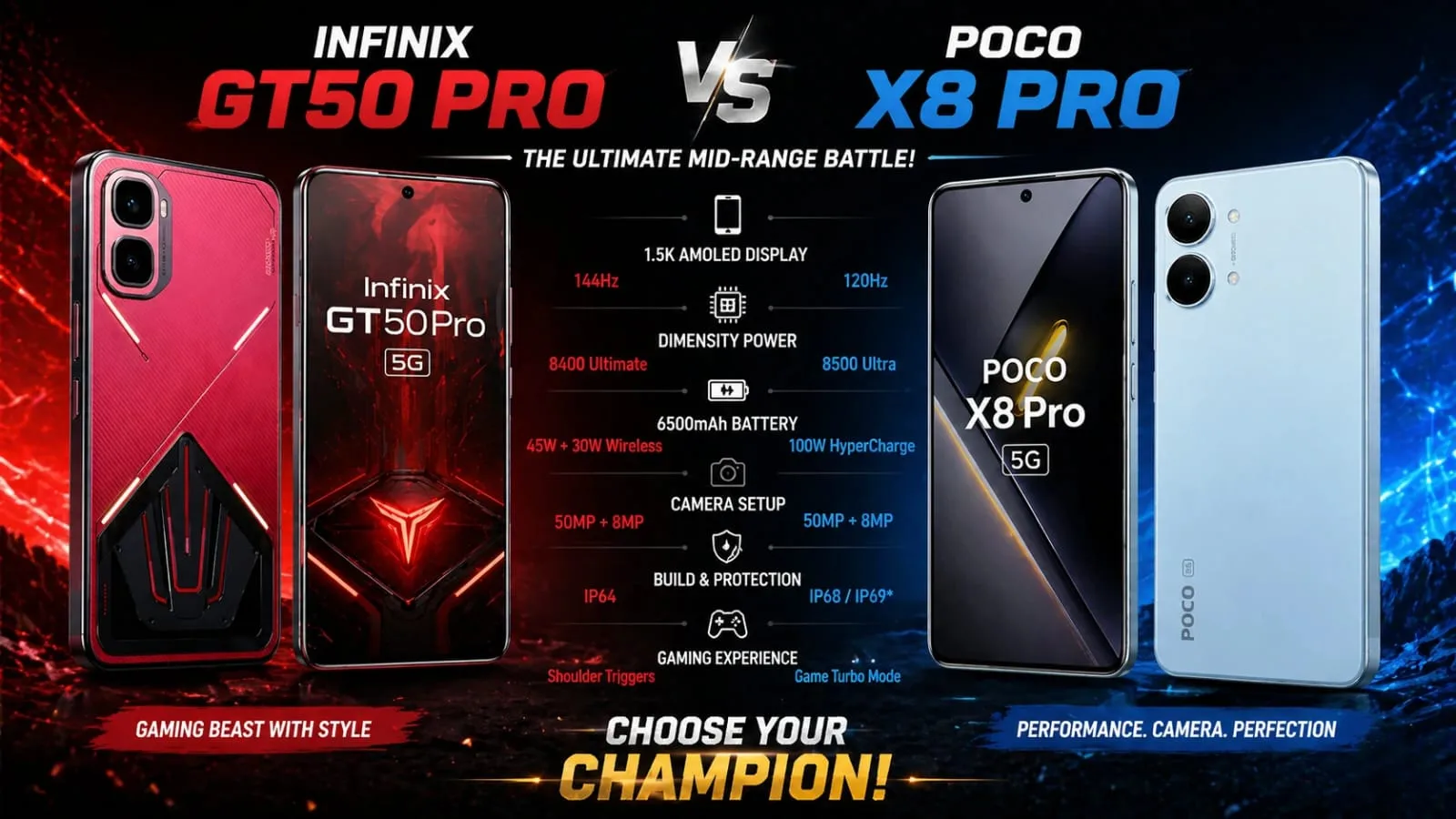
The mid-range smartphone world is set to witness intense competition in 2026. Both the Infinix GT50 Pro and the POCO X8 Pro offer the perfect combination of gaming, battery life, and everyday use. If you’re looking for a phone between ₹30,000 and ₹45,000 that delivers flagship-like performance, this detailed comparison will help you choose the best option. Both phones feature large displays, 6500mAh batteries, powerful MediaTek Dimensity chipsets, and good camera setups. But there are several key differences between them – such as build quality, display brightness, gaming triggers, and charging speed. Let’s take a closer look. Price in India (April 2026) The Infinix GT50 Pro is expected to be priced between ₹35,000 and ₹38,000 for the 12GB + 256GB variant in India, while the 512GB model could be priced higher. The POCO X8 Pro starts at ₹32,999 for the 8GB + 256GB variant, while the 12GB RAM variant is available for ₹35,999–₹37,999, along with bank offers. POCO is known for delivering performance and value for its price. Comparison Table Feature Infinix GT50 Pro POCO X8 Pro Display 6.78″ 1.5K AMOLED, 144Hz, 4500 nits 6.59″ 1.5K AMOLED, 120Hz, 3500 nits Processor Dimensity 8400 Ultimate Dimensity 8500 Ultra RAM / Storage 12GB / 512GB 12GB / 512GB Rear Camera 50MP (OIS) + 8MP 50MP Sony IMX882 (OIS) + 8MP Front Camera 13MP selfie camera 20MP Selfie Camera Battery ~6500mAh 6500mAh Charging 45W + 30W wireless 100W HyperCharge Build & Protection IP64, Plastic, Gorilla Glass 7i IP68, Premium Feel Price ₹35,000 – ₹42,000 ₹32,999 – ₹37,999 Design and Build: A Comparison of Compact Powerhouses The Infinix GT50 Pro is specifically designed with gamers in mind. Weighing just 198 grams and measuring 8.2mm thick, the plastic frame and back make it lightweight and easy to use. It features Corning Gorilla Glass 7i protection. Highlights: Pressure sensitivity with dedicated shoulder triggers makes gaming smoother. Available in Red Blaze, Silver Glacier, and Black Abyss. With an IP64 rating, it resists light dust and water splashes. This smartphone features a 6.59-inch display, weighs 201.5 grams, and features an 8.4mm slim design. The device offers IP68 (IP69 in some variants) dust and water resistance, and offers up to IP69 protection in some variants. It offers excellent visual appeal and durability for everyday use and outdoor activities. Winner: The POCO X8 Pro takes the lead due to better protection and premium build, while the Infinix GT50 Pro offers a better gaming experience. Display: Brightness vs. Refresh Rate Display The screens of both smartphones are their hallmarks. The Infinix GT50 Pro features a 6.78-inch high-resolution 1.5K AMOLED display, which gives it a premium look and feel. The device boasts a 1208 x 2644 pixel resolution, a 144Hz smooth refresh rate, 330Hz touch response, and 4500 nits peak brightness. This device performs well for both gaming and watching movies. The device also features Gorilla Glass 7i protection with 230Hz PWM dimming. The large display provides an immersive content viewing experience. The POCO X8 Pro features a 6.59-inch 1.5K AMOLED display with a resolution of 1268 x 2756 pixels. It features a 120Hz refresh rate, 3500 nits peak brightness, Dolby Vision, HDR10+, and 3840Hz PWM dimming as its key advanced technologies. Wet Touch 2.0 provides smooth and improved touch response even with wet hands or in the rain. Winner: The Infinix GT50 Pro offers a smoother gaming experience due to its larger display and higher refresh rate, while the POCO X8 Pro is better in color quality and outdoor use. Camera: Daylight shots vs video and selfies Camera: Daylight shots vs. video and selfies camera The Infinix GT50 Pro features a 50MP main sensor (with OIS) and an 8MP ultrawide lens. The front camera features a 13MP camera, which delivers good detail and color in daylight. This smartphone supports 4K 60fps video recording, but the camera performs only averagely in low light. The POCO X8 Pro features a 50MP Sony IMX882 main camera with OIS and large 1.6μm pixels, along with an 8MP ultrawide sensor. The front camera is 20MP, perfect for clear selfies and smooth video calling. The POCO smartphone boasts better dynamic range, portrait mode, and 4K@60fps video quality, making it a strong contender. Winner: The POCO X8 Pro offers a great camera and selfie experience. Performance: Raw Power vs Stable Gaming Processor Performance is the most important aspect of both phones, determining the gaming experience. The phone is powered by the MediaTek Dimensity 8400 Ultimate (4nm) SoC, which powers the Infinix GT50 Pro. The device features a Mali-G720 MC6 GPU, along with 12GB of LPDDR5X RAM and fast UFS 4.1 storage. The HydroFlow liquid cooling system (6437mm² area) helps maintain stable temperatures during long gaming sessions. The N1 network chip provides strong signal and smooth connectivity, with minimal lag. The shoulder triggers are also provided with advanced customization features, with 8 mapping points and 10 levels of pressure sensitivity. Games like BGMI and COD Mobile offer stable performance at 90-120 FPS. The POCO X8 Pro phone is powered by an advanced and powerful chipset, the MediaTek Dimensity 8500 Ultra (4nm). The Mali-G720 MC8 GPU, 8GB/12GB of RAM, and UFS 4.1 storage deliver strong benchmark performance. HyperOS 3’s system optimizations elevate both sustained performance and multitasking. Game Turbo mode further enhances gaming. Winner: The POCO X8 Pro is superior in raw power and overall performance, while the Infinix GT50 Pro is a gamer favorite due to its gaming-specific features (triggers and cooling). Also Read :  iPhone 17 Complete Information – Is It Worth Buying? Battery Performance vs. Fastest Charging Support Battery and Charging: King? Both phones feature a large 6500mAh battery, which is quite impressive in this price range. The Infinix GT50 Pro smartphone offers 45W wired fast charging, along with 30W wireless and 10W reverse charging. Its liquid cooling system and efficient chipset provide a comfortable 1.5-day battery life. Wireless charging proves to be a convenient and practical feature for gaming users. The POCO X8 Pro features 100W HyperCharge, which takes the phone from discharge to full … Read more

iPhone 17 Pro vs OPPO Find X9s Pro: Epic Showdown 2026

iPhone 17 Pro vs OPPO Find X9s Pro: Epic Showdown 2026

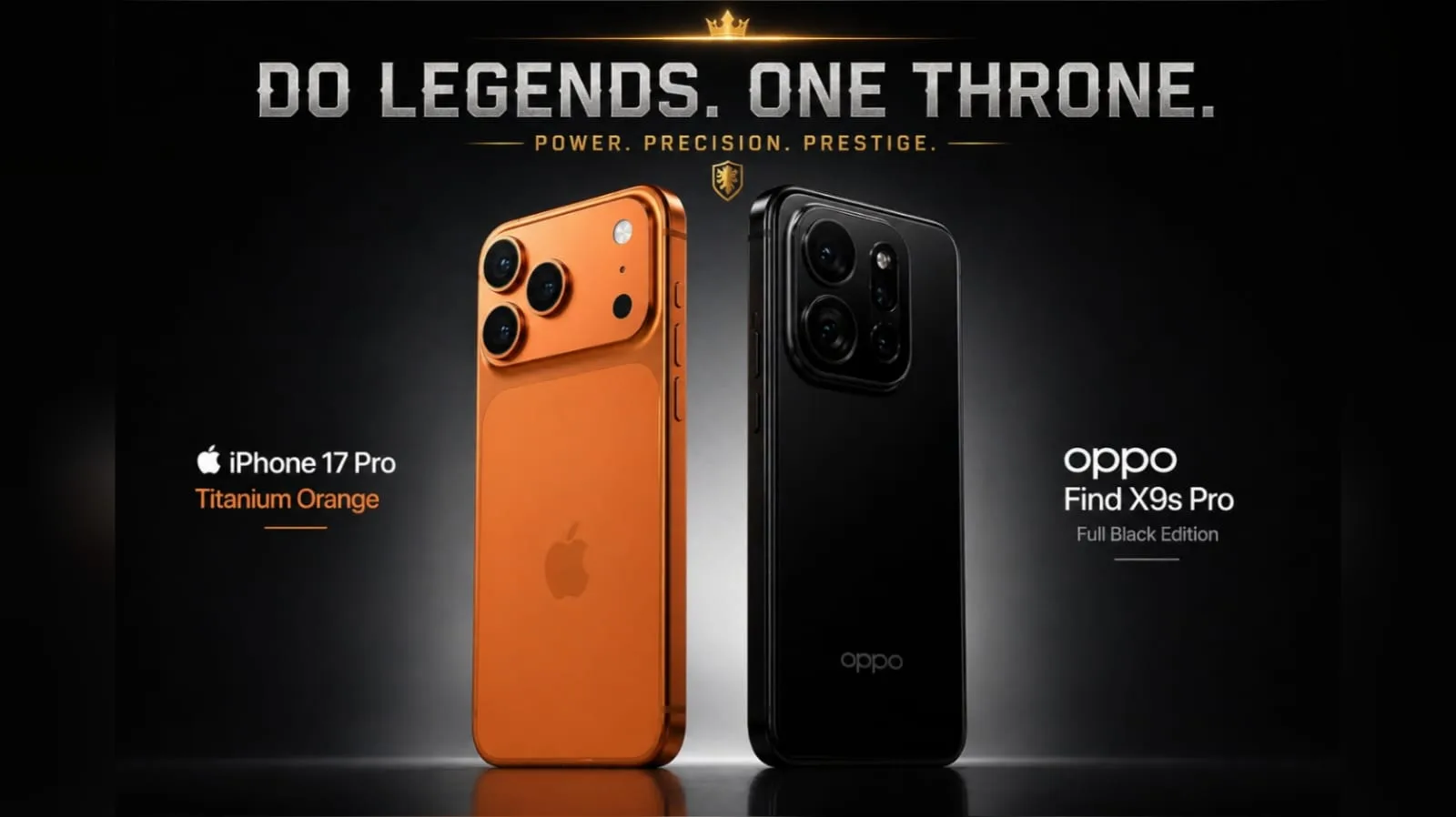
The smartphone world is witnessing a fierce battle between two powerful, compact flagships: Apple’s iPhone 17 Pro and OPPO’s Find X9s Pro. If you’re looking for a premium phone that fits comfortably in one hand without compromising on top-tier features, this head-to-head is for you. The iPhone 17 Pro sports a sleek titanium-like orange finish with its signature triple-lens arrangement, while the OPPO Find X9s Pro’s bold, large camera module comes in clear or dark casing. But looks are just the beginning. Let’s delve deeper into the design, display, performance, camera, battery, and more. So, let’s see which phone is worth your hard-earned money. Pricing and Availability iPhone 17 Pro: Priced starting at around $1,099 (approximately ₹1,09,999+ in India), reflecting its premium ecosystem. OPPO Find X9s Pro: Pricing is more competitive, with prices expected to range from ₹70,000–₹90,000 in India from the base to the top variants (recently launched in China, expected to arrive in India/global soon). iPhone vs. OPPO Feature iPhone 17 Pro OPPO Find X9s Pro Display 6.3″ Super Retina XDR OLED, 120Hz, 3000 nits 6.32″ 1.5K LTPO AMOLED, 144Hz Processor Apple A19 Pro (3nm) MediaTek Dimensity 9500 (3nm) RAM / Storage 12GB / 256GB–2TB Up to 16GB / 256GB–1TB Rear Camera Triple 48MP system 200MP + 200MP + 50MP (Hasselblad) Front Camera 18MP selfie camera 32MP Selfie Camera Video Recording Best-in-class 4K Dolby Vision Up to 8K 30fps Processor Apple A19 Pro (3nm) MediaTek Dimensity 9500 (3nm) Operating System iOS 26 (long-term updates) Android 16 + ColorOS 16 Battery ~4,200 mAh 7,025 mAh Charging Fast wired + MagSafe 80W wired + 50W wireless Build & Protection Ceramic Shield 2, IP68 IP68/IP69, ultrasonic fingerprint Price ₹1,09,999+ ₹79,990 – ₹96,000 Design and Build: A Comparison of Compact Powerhouses Both smartphones are specifically designed for users who want a compact, premium experience rather than bulky “Max” or “Ultra” models. iPhone 17 Pro: Its approximately 6.3-inch display features a refined and minimalist design, excellent button placement, excellent in-hand feel, and supports an adaptive refresh rate of up to 120Hz. It weighs approximately 200g and has a top-tier IP68 rating, providing complete protection against water and dust. OPPO Find X9s Pro: It features a flat display with uniform, ultra-thin bezels, making it a stylish device. The device is available in several vibrant and attractive colors. It features robust IP68/IP69 protection and a 3D ultrasonic in-display fingerprint scanner. Winner: For most users, both are equal—the iPhone with its robust ecosystem, and the OPPO with its trendy colors and simple design. The images perfectly illustrate how both prioritize premium materials, but with different visual signatures. Display: Brightness vs. Refresh Rate From scrolling through social media to watching videos, the display is crucial to a great user experience. iPhone 17 Pro: 6.3-inch OLED Super Retina XDR display, 1-120Hz adaptive refresh rate, 3000 nits peak brightness for vibrant colors and a great HDR experience. With a resolution of approximately 2622 x 1206 (~460 ppi), this display delivers crisp and bright visuals even outdoors. OPPO Find X9s Pro: 6.32-inch premium LTPO AMOLED screen (or similar high-quality panel) with a 144Hz refresh rate for a great experience. It comes with a 1.5K resolution (approximately 1216 x 2640) and 1800+ nits of peak brightness, which is impressive, but doesn’t offer the same sharp visibility in sunlight as Apple. Winner: The iPhone 17 Pro outperforms the other phones with its high brightness and precise color calibration – ideal for outdoor use and content creation. With a 144Hz display, the OPPO offers users ultra-smooth scrolling and a great gaming experience. Camera: Megapixels vs. Computational Magic Camera Comparison: Megapixels vs. Computational Magic The camera often plays a decisive role – and the hardware differences are clearly visible in the photo you provided. iPhone 17 Pro: It features a triple 48MP Fusion Camera system (main, ultra-wide, and telephoto) with advanced sensor-shift OIS, ProRes, Apple Log, and Pro Video features. It delivers consistency, natural color, stable output, and excellent low-light photography in all conditions. It’s also strong in video recording, making it a favorite for vlogging and boasts excellent stabilization. OPPO Find X9s Pro: It features an aggressive quad-like setup with dual 200MP sensors, a 200MP periscope (3x zoom), and a 50MP ultra-wide and color lens. This camera, tuned with Hasselblad, excels at portraits and color science, as well as zoom and high-resolution stills. Some reviews mention its excellent dynamic range and impressive macro capabilities. Winner: While this is entirely a personal preference, the iPhone 17 Pro offers better video quality and a smoother point-and-shoot experience. The OPPO Find X9s Pro’s dual 200MP camera setup offers excellent detail and excellent zoom, which will appeal to large file editors. Both excel in practical tests, but OPPO pushes hardware limits while Apple excels at software processing. Performance: Raw Power vs. Efficiency Both smartphones are capable of delivering top-tier performance. iPhone 17 Pro: This device is powered by the A19 Pro (3nm) processor, featuring a 6-core CPU, 6-core GPU, 12GB of RAM, and a powerful Neural Engine for Apple Intelligence. This device delivers stable performance, a smooth gaming experience, and optimized iOS. Benchmark tests demonstrate excellent efficiency and long-lasting smoothness. OPPO Find X9s Pro: This device’s MediaTek Dimensity 9500 (3nm), 16GB of LPDDR5X RAM, and UFS 4.1 storage elevate it to flagship level. This device scores high on AnTuTu due to its high-performing multi-core system and AI capabilities. ColorOS 16 (Android 16) offers enhanced customization, multitasking, and features like an IR blaster. Winner: Depends on your personal preference. The iPhone’s simple ecosystem, video editing, and excellent optimization set it apart, while the Oppo offers raw performance, higher RAM, and Android customization. Also Read :  iPhone 17 Complete Information – Is It Worth Buying? Battery and Charging: Endurance King? Battery and Charging: King? The difference between a great phone and a great phone for everyday use is its battery life. iPhone 17 Pro: A battery of approximately 4,000–4,250 mAh, combined with the A19 Pro’s optimizations, delivers reliable all-day backup. It offers fast wired charging (up to 50% … Read more

Huawei Mate 80 Pro: Powerful Beast You Must See

Huawei Mate 80 Pro feature image with key specifications

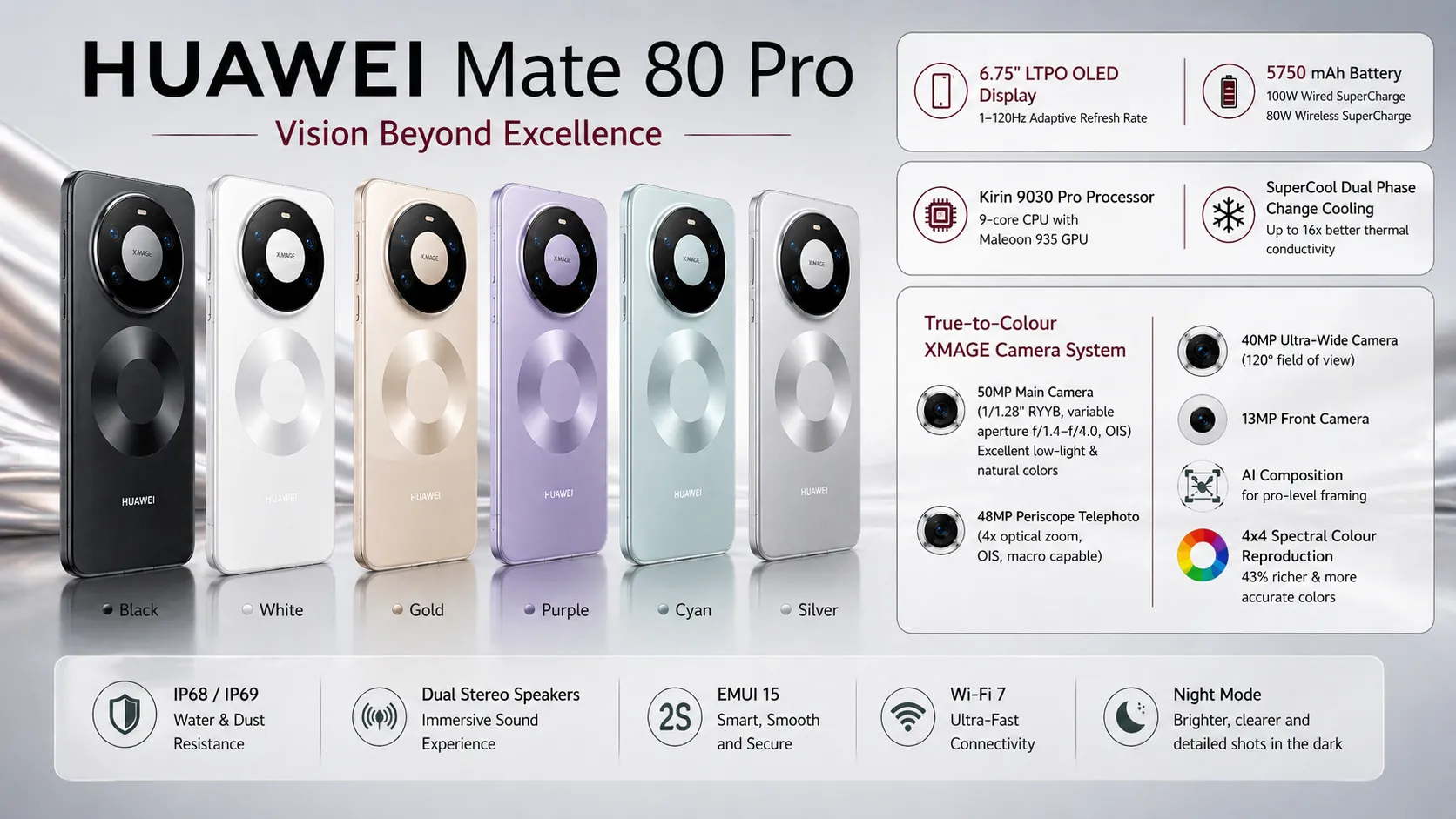
Are you still looking for the perfect flagship smartphone? Wait… because the Huawei Mate 80 Pro has entered the market in 2026 and changed the game! Huawei‘s Mate series has always been known for innovation, premium design, and excellent camera performance. Launched in China in November 2025 and available globally in February-March 2026, the Huawei Mate 80 Pro once again proves that the company remains a strong contender among the top smartphone brands in the flagship smartphone segment. With a Kirin 9030 Pro chipset, a massive 5750mAh battery, 100W SuperCharge, a True-to-Color XMAGE camera system, advanced AI features, and a Dual Space Ring Design – this phone strives to meet user expectations in terms of photography, performance, battery life, and durability. In 2026, if you’re looking for a high-end device that can handle everyday use, professional photography, gaming, and long battery life with ease, the Huawei Mate 80 Pro, launched in 2025, could be your top choice. In this detailed review, we’ll try our best to highlight 8 key reasons why you should buy this phone. We’ll cover every feature in detail to make your decision easier. Highlight key Stunning LTPO OLED DisplayPremium Design & BuildNext-Gen Kirin ProcessorAdvanced Camera SystemLong-Lasting BatterySuper Fast ChargingHarmonyOS Experience5G ConnectivityGaming-Ready Performance Huawei Mate 80 Pro Price in India and Availability (2026) The India launch is still awaited, but its expected price is estimated to be ₹75,990 to ₹99,999 (depending on the variant). Globally, it’s priced around $849-$1100 (₹70,000-₹95,000). Availability: Check Huawei’s official website, Amazon, Flipkart, or authorized stores. Pre-order offers have also begun in some markets. Alert: The lack of GMS support in India is an important factor – keep this in mind if you use Google services heavily. Huawei Mate 80 Pro Specifications Category Details Height, Weight & Resolution 161.85 mm, 219 g, (2832 × 1280 pixels) Display 6.75-inch LTPO OLED, 120Hz refresh rate, Rear Camera 50MP (main) + 40MP (ultra-wide) + 48MP (telephoto) Front Camera 13MP selfie camera Video Recording Up to 4K (3840×2160) Processor Kirin 9030 / 9030 Pro chipset Operating System EMUI 15 / HarmonyOS (region-based) Fingerprint Sensor In Display fingerprint sensor RAM & Storage 16GB RAM + 512GB storage Colour Black, Green, Gold, White, Cyan (Blue tone) SIM Dual Nano-SIM Battery 5750mAh (typical) Fast Charging 100W wired + 80W wireless fast charging Connectivity 4G LTE, Wi-Fi 7, Bluetooth 6.0, NFC Dust & Water Resistance IP68 + IP69 water & dust resistant Launch November 25, 2025 Price Starting Price ₹1,15,000 – ₹1,20,000/- Also Read: iPhone 17 Complete Information – Is It Worth Buying? Iconic Dual Space Ring Design and Premium Build Quality The phone’s striking Dual Space Ring rear design sets it apart from other phones. The large circular camera module, along with a secondary ring below, creates a striking and luxurious look. The phone is available in Golden, Black, White, and Green color options. Build Quality: Aluminum frame + glass-fiber reinforced plastic back. 2nd Gen Kunlun Glass – 20x better drop resistance. IP68/IP69 water and dust resistance (protected in up to 6 meters of water for a few minutes). Dimensions: Approximately 162 x 76 x 8mm, Weight: 219g – Premium and balanced feel in the hand. The flat-edged design offers a modern look and a comfortable grip. 6.75″ Flat-Edged LTPO OLED Display – A Brilliant Visual Experience 6.75″ Flat-Edged LTPO OLED Display The Huawei Mate 80 Pro features a 6.75-inch LTPO OLED display with a 1280×2832 resolution, a 1-120Hz adaptive refresh rate, and 3000 nits peak brightness. Colors are rich, blacks are deep, and scrolling is super smooth. 1440Hz PWM dimming reduces eye strain. This display is perfect for movies, gaming, and reading. 2nd-Gen Kunlun Glass protects the screen from scratches and drops. Reviews have called the display “gorgeous.” True-to-Color XMAGE Camera System – Natural and Professional Photography Camera System – Natural and Professional Photography The Mate 80 Pro’s camera system is powered by Huawei’s XMAGE imaging technology, which follows the True-to-Color philosophy. The color quality is so accurate and natural, it feels like the real world. Rear Camera Setup: The 50MP main camera (1/1.28″ RYYB, f/1.4–f/4.0 variable aperture, OIS) delivers stunning detail, natural color, and accurate colors in low-light photography. The 48MP periscope telephoto (f/2.1, 4x optical zoom, OIS, macro) delivers crystal-clear long-range photography. The 40MP ultra-wide camera (f/2.2, 120°) delivers a natural look and reduced distortion even in wide-angle shots. This new 4×4 spectral color reproduction delivers up to 43% richer and more accurate colors. Reviews say it’s one of the best camera phones in the industry, especially for portraits, landscapes, and low-light photography. The 13MP front camera delivers clear, high-quality selfies and smooth video calling. The AI ​​composition feature automatically improves framing, helping you click pro-level photos. Helps. Powerful Performance with SuperCool Dual Phase Change Cooling and Kirin 9030 Pro Powerful Performance Kirin 9030 Pro The Huawei Mate 80 Pro’s biggest strength is its superior performance. It features the first-ever SuperCool Dual Phase Change Cooling system, which ensures long-lasting performance. Keeps you cool even during multitasking. This cooling technology improves thermal conductivity by 16 times and reduces temperature rise by approximately 33%. Processor: HiSilicon Kirin 9030 Pro (6nm process) – 9-core CPU with Maleon 935 GPU. This chipset is excellent at power savings and handles multitasking, gaming, and video editing with ease. The smartphone comes with 12GB or 16GB of LPDDR5X RAM, along with 256GB to 1TB of internal storage. Multitasking is absolutely smooth in the 16GB RAM variant. In reviews, users reported that even playing heavy games (like Genshin Impact and PUBG) for long periods of time, there were no lag or heating issues. The phone also offers a very responsive and fast experience in daily use. Massive 5750mAh Battery with Ultra-Fast HUAWEI SuperCharge Massive 5750mAh Battery with Ultra-Fast HUAWEI SuperCharge The battery is the Huawei Mate 80 Pro’s biggest USP. The massive 5750mAh (rated ~5620mAh) battery comfortably lasts 1 to 1.5 days even with heavy use. Charging: 100W Wired SuperCharge – 80-90% charge in 30 minutes. 80W Wireless SuperCharge Reverse wireless charging (for charging … Read more