
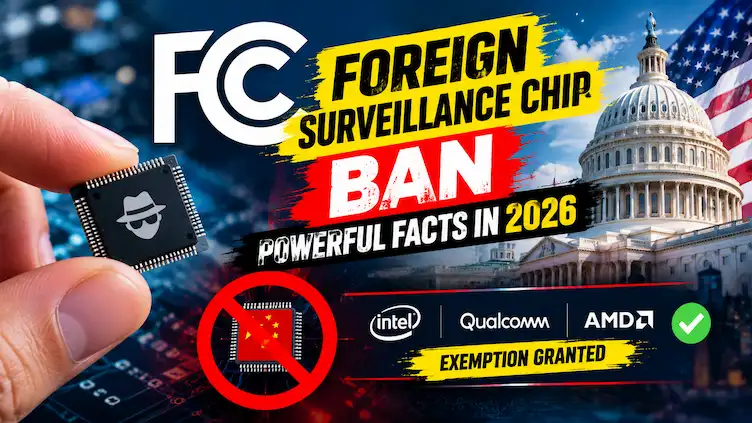
Tell the truth, when you first saw the phrase ‘FCC foreign surveillance chip ban,’ did you think it was about computer chips? I thought the same. Then I looked into it a bit more deeply and found something even more interesting. Actually, this provision is about robots made abroad. Intel, which is one of America’s leading semiconductor companies, has requested special permission to continue using the vehicles in its factories.
In this article, we’ll break down the FCC foreign surveillance chip ban in simple terms. We’ll look at why Intel wants a waiver, what’s still unclear, and what it means for tech companies in the U.S. and readers in India.
In This Article
ToggleHighlights
The FCC foreign surveillance chip ban story started on July 28, 2026, when foreign-made advanced robots were added to the FCC’s restricted list.
In mid-October 2026, Intel officially filed its petition in ET Docket 26-256.
The request is about automated guided vehicles (AGVs) that carry wafers and materials inside chip factories.
Intel hasn’t yet been able to identify any option made in the US that has been officially certified.
The waiver is a request, and the final FCC answer is still pending in the latest reports.
Old robots are not banned from running, but updates and repairs are the big worry.
What Is the FCC Foreign Surveillance Chip Ban in Simple Words?
Now let’s talk about the basics. People online also talk about foreign surveillance chips, but the rule itself talks about robots. On July 28, 2026, the Federal Communications Commission added foreign-made advanced robots and connected power inverters to its Covered List. That list is where the agency puts gear it sees as a risk to national security.
Why does this matter? Because if a product sits on that list, new models cannot get the FCC approval needed to be sold in the USA. Officials say they worry about spying, cyber attacks, and too much dependence on one country, mostly China.
The good news for owners is simple. The FCC did not tell people to throw away robots they already have. So the FCC foreign chip ban mainly blocks new models. The tricky part is what happens when old machines need a software or hardware update.
Why Is Intel Asking the FCC for a Factory Robot Waiver?
Picture a chip factory like a giant, super clean airport. Wafers are the tiny discs that become chips, and they travel from one machine to another all day. Automated guided vehicles do that moving work, on the floor and also on tracks near the ceiling.
Under the FCC foreign surveillance chip ban, Intel says its foreign-made factory robots are in a gray zone. Its petition says it cannot find proven American replacements, and swapping them out would take years. In its view, even a short break could cut chip output, and that is a national security issue too.
In my experience, big machines are never “set it and forget it.” Even a small shop needs spare parts and fixes. A busy chip plant needs them even more. That is why the Intel factory robots waiver matters. Intel wants clear permission to keep maintaining and updating these vehicles, and it also said the FCC guidance feels unclear, so it asked early to stay safe.
Is the Intel Exception Really Approved Yet?
This is where many headlines get confusing. Some titles make it sound like the exception is already final. Based on the latest reports I found, Intel has asked for a waiver. The case sits in ET Docket 26-256, and the FCC has not given a clear final answer yet. So please do not treat it as a done deal.
Also, the FCC foreign surveillance chip ban is not a total wall. This rule allows approval of some new versions of foreign-made robots based on certain conditions. That means a company can ask the FCC for permission, and the agency can say yes under set rules. The FCC has used waiver tools on other restricted gear before, so a waiver is possible, but nobody can promise it.
What Could the FCC Do Next?
There are three simple outcomes. The FCC can approve Intel’s request fully. It can approve it with limits, such as only for certain vehicles. Or it can say no and ask Intel to find another path. I would not bet on any of them yet.
How Does the FCC Foreign Surveillance Chip Ban Affect US Tech Companies?
Now let’s talk about the bigger picture. Intel is the loud example today, but it will not be the last. Any company that uses foreign-made robots in warehouses, labs, or factories may ask the same question: can we still fix and update what we already own?
Here is how the FCC chip restrictions may touch the tech world:
- Chip companies might need new regulatory guidelines for vehicles and transportation systems running in factories.
- Warehouse and EV companies may need to check which robot brands they use.
- Foreign robot sellers may find it hard to launch new models in the USA.
- American robot makers can take advantage of this situation to boost their business.
The FCC foreign surveillance chip ban’s impact on the US tech industry has two sides. The rule may protect sensitive systems. However, it may also slow plants that depend on parts and tools made abroad. The truth is, both things can be right in their own ways.
The Good, the Bad, and the Confusing
If something is good, I will just call it good. The goal behind the FCC foreign surveillance chip ban is fair. Robots have cameras, sensors, and Wi-Fi, so people are right to ask who controls the software. A rule that pushes companies to think about security is not a bad idea.
However, the bad part is the timing. Chip factories are a top priority for the USA right now, and no one wants delays there. Also, Intel says the guidance is unclear. Unclear rules cost money, because companies freeze projects while they wait for answers.
The confusing part is the word “foreign.” The rule covers robots made in any foreign country, even though China is the clear focus. So not every foreign robot is a Chinese robot. If you think as I do, you want rules that are strict on real risks and simple for honest businesses.
What Does This Mean for Readers in India?
If you live in India, it’s natural to wonder how this rule in the US could affect you. Well, India is a big tech partner of the USA. Many Indian firms sell software and services to American factories, and some sell hardware too. When an American company chooses a new robot supplier, Indian businesses might get new opportunities. However, they may also have to complete some new documents and formalities.
Also, this story shows how fast tech rules can shift. A student in Pune or a founder in Bengaluru who plans to sell robotics to American buyers should watch the FCC foreign chip ban news and check product approvals early. A small check today can save months later.
My Final Thoughts on the FCC Foreign Surveillance Chip Ban
Tell me the truth, the story is less about one company and more about a hard question. How do you protect national security without hurting the factories that make the chips? The FCC foreign surveillance chip ban tries to answer the first part, while Intel’s petition reminds everyone about the second part.
For now, I would keep an eye on the FCC’s decision in the Intel case. It will show how strict the agency plans to be with machines already running inside American plants. Until then, treat every headline with care and check the details.
Disclaimer: This article is for general information only. Details come from news reports available at the time of writing, and the FCC case is still developing, so facts may change. Please check official FCC documents and trusted news sources before making business or legal decisions. This is not legal or financial advice.










FAQ's
What is the FCC foreign surveillance chip ban?
It is a popular name for the FCC rule that added foreign-made advanced robots to its Covered List on July 28, 2026, mainly over spying and cyberattack fears.
Why did Intel ask the FCC for a waiver?
Intel wants to keep running and updating foreign-made factory vehicles that move wafers. It says no proven US replacement exists, and a stoppage could hurt American chip output.
Has the FCC approved the Intel exception?
Not yet, based on the latest reports. Intel filed its request in mid-October 2026 in ET Docket 26-256, and the FCC decision is still pending.
Does the FCC chip ban stop companies from using robots they already own?
No. Robots already in use stay legal, and the rule mainly blocks new foreign-made models. The confusion is about whether updates and repairs to older covered machines are allowed.
Which robots does the FCC foreign chip ban cover?
It covers foreign-produced advanced robotic devices, such as factory transport vehicles, warehouse robots, and walking robots. The same FCC action also listed connected power inverters.

Deepak Kumar is the founder and author of Techallrounder.com. He covers the latest technology news, smartphone and laptop reviews, gadget comparisons, buying guides, and tech tips. His goal is to provide accurate, easy-to-understand, and up-to-date information that helps readers make better technology decisions.