
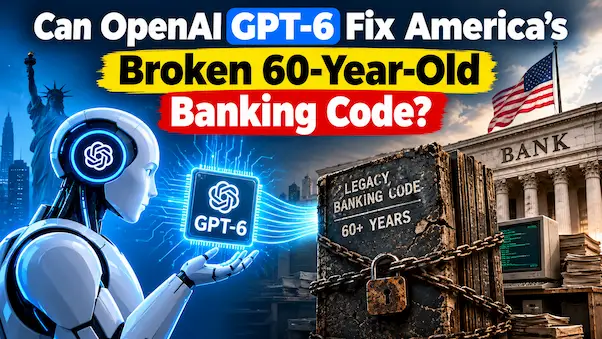
Many big banks still rely on an old computer language from 1959, COBOL. But now OpenAI GPT-6 is here, and people are asking a big question: Can OpenAI GPT-6 modernize the old banking code or not? Come on, let’s understand this in a simple way without any fuss.
Last month, my cousin living in Texas tried to send money to his sister in Hyderabad on a Sunday. The app replied, ‘Try again on Monday.’ But honestly, even in a digital age like 2026, who likes waiting until Monday for something? That tiny moment made me curious to find out what’s really going on behind our banks. The answer shocked me.
In This Article
ToggleHighlights
- COBOL was created in 1959, and many banks still use it.
- OpenAI GPT-6 launched in September 2026 for approved business testers, then reached ChatGPT in October 2026.
- AI can read and explain old code fast, but humans must check every step.
- I found no official proof that OpenAI GPT-6 has already rewritten a real bank’s core system.
- Whether it’s America or India, banks in both countries are affected by this problem, but the way they deal with it is different.
- The safe way is to take small steps, carefully check each stage, and keep human supervision in place.
What Is the 60-Year-Old Banking Code Everyone Talks About?
Think of your bank like an old house. The walls look fresh, and the app looks smart. However, deep inside, the pipes are very old. The old pipeline system is considered the main banking system, much of which was developed in the COBOL programming language.
COBOL is a language made in 1959 for business work like payments, balances, and interest. Fortune once quoted an Accenture leader who said that when you dig into the core of most major banks, you reach COBOL. That tells you how deep this goes.
Why Do Banks Still Use COBOL?
Honestly, it is because the code works. It has handled money for decades. Nobody wants to touch something that moves millions of dollars every day. Also, many old programs have poor documentation, so new engineers struggle to understand them.
Moreover, switching is costly. When Commonwealth Bank of Australia replaced its core system, the work took five years and cost almost 750 million dollars. So you can see why banks move slowly.
Can OpenAI GPT-6 Modernize Legacy Banking Code?
Short answer: it can help a lot, but it cannot do the job alone. OpenAI’s president called OpenAI GPT-6 a generational leap in ability, which sounds exciting. Still, I have not seen any official report saying it has already rebuilt a bank’s core system. So treat big claims with care.
Here is where the OpenAI GPT-6 banking code idea makes sense. AI tools can read old COBOL, explain it in plain English, and suggest modern code in Java or Python. IBM and GitHub leaders said something similar in 2023, but they also stressed that humans must stay involved at every step.
How AI Can Rewrite 60-Year-Old Banking Code Step by Step
If you think like I do, you want a simple plan. Here is how AI code modernization usually works:
- Read: The AI scans old files and maps how they connect.
- Explain: It writes simple notes on what each part does.
- Rewrite: It suggests new code in a modern language.
- Test: Engineers run old and new versions and compare the results.
- Move slowly: The bank switches one small piece at a time.
A Capco project is a good example. It reviewed more than 2 million lines of COBOL for a global bank, and AI helped study around 150,000 of those lines deeply. That was a trial, not a full switch, but it shows the direction.
What Can Go Wrong With AI for Legacy Banking Systems?
Now the not-so-good part. The code used in the banking system manages real money, so even a small mistake can be costly. One developer noted that an older AI model made a wrong tax calculation while converting COBOL. That is exactly the kind of error banks cannot accept.
Also, Stanford researchers once found that people using an AI coding helper often wrote less secure code. So OpenAI GPT-6 needs strict checks, security reviews, and plenty of testing. Banks must also follow tough laws, so every change needs clear records.
I learned this in a small way myself. Once, an AI tool explained a messy spreadsheet formula for me and saved an hour. Still, I double-checked every result. Even if OpenAI GPT-6 is fast, a bank needs expert people. AI saves time on reading and drafting, but it does not replace careful humans.
What Should Banks Ask Before Using AI for Legacy Banking Systems?
Before any bank trusts OpenAI GPT-6, I think a few simple questions come first. These questions matter more than any fancy demo.
- Can the AI explain its work in plain words, so a human can check it?
- Do the old and new programs give the same answer every single time?
- Is customer data safe while the AI reads the old code?
- Who is responsible if a mistake slips through?
- Can the bank go back to the old system quickly if something breaks?
In my experience, teams that ask these questions early save a lot of pain later. Therefore, a slow start is often the fastest way to finish.
How Is Banking Software Modernization Different in the USA and India?
In the USA, many large banks run very old mainframe systems, so banking software modernization is a big and costly job. Regulators watch closely, so banks move with caution.
In India, the story is mixed. Many banks use older core systems too, but not all of them run on COBOL. Meanwhile, UPI made payments feel instant, which shows that modern layers can sit on top of older systems. So AI-powered banking code modernization for banks in the USA and India will look different in each country, but the need is the same.
Should Banks Trust OpenAI GPT-6 Today? My Honest View
Tell me the truth, would you let AI rewrite the code that holds your savings? I would not, at least not alone. In my opinion, OpenAI GPT-6 is a great helper, not a magic fix.
Here is what I like. It can save months of reading work. It can turn confusing code into simple notes. It can also help new engineers learn old systems quickly. That is real value.
Here is what I do not like. The proof for full bank rewrites is still thin, and big AGI talk does not fix a payment bug. Also, the strongest versions have limited access, with extra safety rules for cyber work. So banks should test OpenAI GPT-6 on small, low-risk programs first.
What Should You Do as a Customer or Tech Learner?
If you are a bank customer, relax. Your money will not move to AI-written code tomorrow. Banks will test for years first. If you are a student or developer, though, learning basic COBOL plus AI tools can be a smart career move, because fewer people know old code well.
Also, keep an eye on the news. AI in banking technology is moving fast, and new updates on OpenAI GPT-6 may appear soon.
Final Thoughts: Can OpenAI GPT-6 Really Modernize Banking Code?
So, can OpenAI GPT-6 modernize America’s 60-year-old banking code? It can do tough tasks like reading, explaining, and generating new code quickly. Still, the whole job needs people, testing, and patience. If you ask me, the future is with AI and humans, not just AI alone.
Disclaimer: This article is for general information only. It is not financial, legal, or technical advice. Facts, prices, and product details about OpenAI GPT-6 may change, so please check official sources before making decisions.









FAQ's
Can OpenAI GPT-6 modernize legacy banking code?
It can help read, explain, and draft new code from old COBOL programs. Still, banks need human experts and heavy testing, because small mistakes can affect real money.
What is COBOL and why do banks still use it?
COBOL is a business language from 1959. Banks still use it because it works reliably, and replacing core systems is slow, costly, and risky for customers.
Is OpenAI GPT-6 available to the public?
Yes, partly. Paid ChatGPT plans get GPT-6 Sol, and Free and Go plans get GPT-6 Luna. The stronger Astra version started with approved business testers.
How can AI rewrite 60-year-old banking code?
AI reads old files, explains each part, suggests modern code, and helps with tests. Engineers compare old and new results before moving one piece at a time.
Is it safe to use AI for banking software modernization?
It can be safe only with strict controls. Banks need security checks, clear records, human review, and a plan to go back to the old system quickly.
How much does GPT-6 Astra cost?
Reports say GPT-6 Astra costs 10 dollars per million input tokens and 50 dollars per million output tokens through the API. ChatGPT itself has free and paid plans.
Will AI replace COBOL programmers?
Not soon. AI speeds up reading and drafting, but banks still need people who understand business rules, laws, and testing. In fact, skilled COBOL knowledge may stay valuable.
Do Indian banks also use old core banking systems?
Many do use older core systems, but not all run on COBOL. India also has modern layers like UPI, so each bank’s path to modernization looks different.
What are the biggest risks of AI code modernization?
The main risks are wrong logic, weak security, missing records, and over-trust in AI. One wrong calculation in payments can hurt customers, so careful testing always comes first.
Has OpenAI GPT-6 already rewritten a real bank’s core system?
I found no official public proof of that yet. Other AI projects have tested COBOL conversion on samples, but a full core rewrite by GPT-6 is not confirmed.

Deepak Kumar is the founder and author of Techallrounder.com. He covers the latest technology news, smartphone and laptop reviews, gadget comparisons, buying guides, and tech tips. His goal is to provide accurate, easy-to-understand, and up-to-date information that helps readers make better technology decisions.