
Snapdragon 7 Gen 4 vs 7s Gen 4: Big Difference Explained!
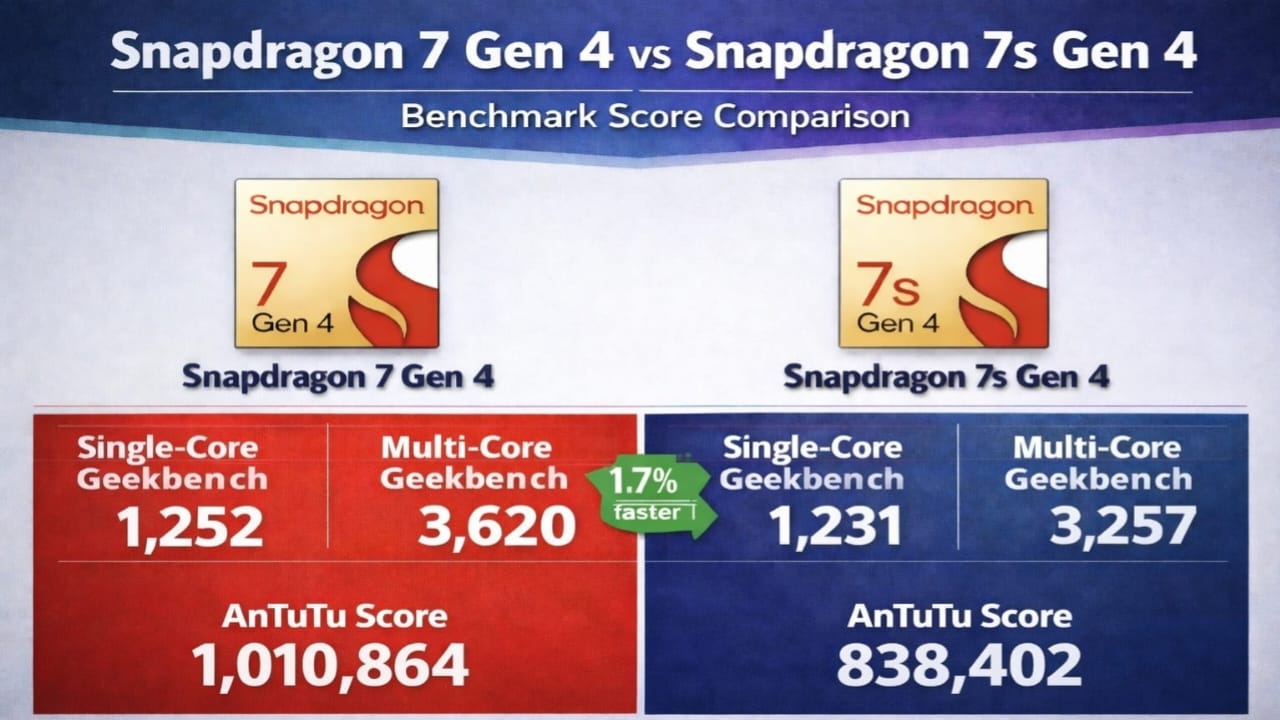
The Snapdragon 7 series is becoming quite popular in mid-range smartphones these days. On May 15, 2025, Qualcomm introduced the Snapdragon 7 Gen 4 with a strong performance focus. A few months later, on August 19, 2025, the Snapdragon 7s Gen 4 arrived, aiming for a more balanced experience with improved battery efficiency. This chipset was first launched in the Redmi Note 15 Pro+. If you’re trying to decide which chipset is right for your next smartphone, this article will help you clear things up. We’ll look at real-world benchmarks like Geekbench and AnTuTu, as well as factors like performance, AI features, battery life, gaming, and camera capabilities. Before we get into the full comparison, let’s quickly review the benchmark scores shown in the images (Geekbench single-core: 1,252 vs. 1,231; multi-core: 3,620 vs. 3,257; AnTuTu: 1,010,864 vs. 838,402). Highlights Snapdragon 7 Gen 4 Snapdragon 7s Gen 4 Better overall performance (Geekbench & AnTuTu leader) Balanced performance for daily use Strong multi-core power (~11% faster) Slightly better power efficiency (low TDP ~5W) Powerful GPU (Adreno 722) for gaming Decent CPU for normal tasks LPDDR5X RAM + UFS 4.0 (faster speed) Good for casual gaming Wi-Fi 7 & Bluetooth 6.0 support LPDDR5 RAM + UFS 3.1 4K @ 60fps video recording 4K @ 30fps support 65% improved AI performance Wi-Fi 6E & Bluetooth 5.4 Best for gaming, editing & heavy tasks Better battery backup in light usage Key Specs of the Snapdragon 7 Gen 4 and 7s Gen 4 Both chipsets are built on the 4nm TSMC process, which offers good power efficiency. However, there are differences in architecture and clock speeds: Snapdragon 7 Gen 4: Core configuration consists of 1x 2.8 GHz Cortex-A720 (Prime), 4x 2.4 GHz Cortex-A720 (Performance), and 3x 1.8 GHz Cortex-A520 (Efficiency). GPU: Adreno 722 graphics processor. RAM support includes LPDDR5X with speeds up to 4200 MHz. Features high-speed UFS 4.0 storage. Connectivity includes Wi-Fi 7, Bluetooth 6.0, and a high-speed 5G modem. Includes triple 12-bit AI ISPs with 200MP camera support and 4K recording at 60fps. AI: Packs a 65% stronger AI engine than before, thanks to the advanced Hexagon NPU. Thermal Design Power is around 6–10 watts. Snapdragon 7s Gen 4: The processor features a configuration of 1× Cortex-A720 (2.7GHz), 3× Cortex-A720 (2.4GHz), and 4× Cortex-A520 (1.8GHz). Graphics Processor: Adreno 810 RAM Supports LPDDR5 memory running at up to 3200 MHz. Offers UFS 3.1 storage for quick data access Connectivity options include Wi-Fi 6E and Bluetooth 5.4. ISP supports up to a 200MP camera but limits video recording to 4K at 30fps. AI: Uses a Hexagon NPU, however performance is lower than the 7 Gen 4. A TDP of about 5W provides better energy efficiency. Key differences: The 7 Gen 4 has more performance cores (4+3 vs 3+4), faster RAM, better GPU clocks, UFS 4.0, and advanced connectivity. The 7s Gen 4 is slightly lighter and more efficient. Benchmark Comparison: Who’s Ahead? Benchmark Comparison: Who’s Ahead? Geekbench Score (CPU-Focused):Single-Core: Snapdragon 7 Gen 4 – 1,252 | 7s Gen 4 – 1,231 (7 Gen 4 ~1.7% ahead)Multi-Core: 3,620 vs 3,257 (7 Gen 4 ~11% better) The difference in single-core performance is small, meaning both will perform about the same for daily tasks (app opening, browsing). The 7 Gen 4 shows stronger multi-core performance, making it better for multitasking, video editing, and demanding apps. Also Read : iPhone 17 Complete Information – Is It Worth Buying? AnTuTu Score (Overall Performance): 7 Gen 4: 1,010,864 7s Gen 4: 838,402 (7 Gen 4 ~20% ahead) AnTuTu breakdown (according to Gizmochina data): CPU: 309,273 vs 276,892 GPU: 323,797 vs 211,590 (53% better GPU in 7 Gen 4) Memory: 182,776 vs 162,373 UX: 195,019 vs 187,547 There’s a big gap in GPU scores, making the 7 Gen 4 the clear winner in gaming and graphics-heavy tasks. In some tests, the 7 Gen 4 even scores above 1.1 million in AnTuTu, while the 7s Gen 4 hovers around 850K-950K. Gaming Performance The Snapdragon 7 Gen 4 is better for gaming because:The Adreno 722 GPU has Snapdragon Elite Gaming features (Adaptive Performance Engine).Titles like BGMI, COD Mobile, and Genshin Impact run better with smooth high-FPS gameplay. Improved thermal management and higher clock speeds result in less throttling during long sessions. The 7s Gen 4 is good for light gaming and casual use, but frame drops may occur at high graphics settings. If you’re a heavy gamer, choose the 7 Gen 4. Camera, AI, and other features Both chips support 200MP cameras, but the 7 Gen 4 stands out with its improved AI-ISP and 4K@60fps video recording. The 7 Gen 4 excels in photo processing and low-light performance.AI features: The 7 Gen 4 has 65% better AI performance (generative AI, image generation, smart assistant). On-device AI tasks will be faster.Display and media: Both support HDR10+, but the 7 Gen 4’s improved GPU provides a smoother 144Hz refresh rate experience.Battery efficiency: Because of its 5W TDP, the 7s Gen 4 may offer improved battery life in everyday usage scenarios. The 7 Gen 4 may consume slightly more power during heavy use, but this is balanced by the efficient 4nm process. Which one to choose? Buying guide Choose the Snapdragon 7 Gen 4 if:You want gaming, multitasking, video editing, or AI features.Better future-proofing (Wi-Fi 7, faster RAM, UFS 4.0).Available in phones like the Nothing Phone (4a) Pro, Realme 16 Pro, Vivo V70, Honor 400 series, and more. Choose the Snapdragon 7s Gen 4 if:Budget is tight, and it’s enough for daily use (social media, browsing, light gaming).Battery performance and minimal heating are top priorities.It could appear in select variants of the Nothing Phone (4a) or similar budget smartphones. Also Read : Samsung Galaxy S26 Ultra 5G: 5000mAh battery, Snapdragon 8 Elite Gan 5, 200MP Camera. Conclusion: Benchmarks and specifications clearly indicate that the Snapdragon 7 Gen 4 is the overall winner, especially in GPU and multi-core performance. It offers a “premium mid-range” experience, while the 7s Gen 4 falls into the “value mid-range” category. If your … Read more