

So you’ve heard about ChatGPT everywhere, right? On YouTube, in news articles, from your friends, and maybe even from your boss. And now you want to actually understand what it is, how it works, and most importantly, how to use ChatGPT properly.
Tell me the truth, most people just open ChatGPT, type something random, and then say, “Man, this isn’t anything special.” The problem is not ChatGPT. The problem is they don’t know how to talk to it. And that’s exactly what this article is going to fix.
In This Article
ToggleHighlight key
| Topic | Details |
|---|---|
| Tool Name | ChatGPT |
| Developer | OpenAI |
| Launch Year | November 2022 |
| Free Plan | Available |
| Paid Plans | Plus ($20/month), Pro ($200/month) |
| Key Features | Text, Image, Voice, Code, File Analysis |
| Best For | Students, Bloggers, Developers, Marketers |
| Focus Keyword | How to Use ChatGPT |
What is ChatGPT?
Why is ChatGPT So Popular?
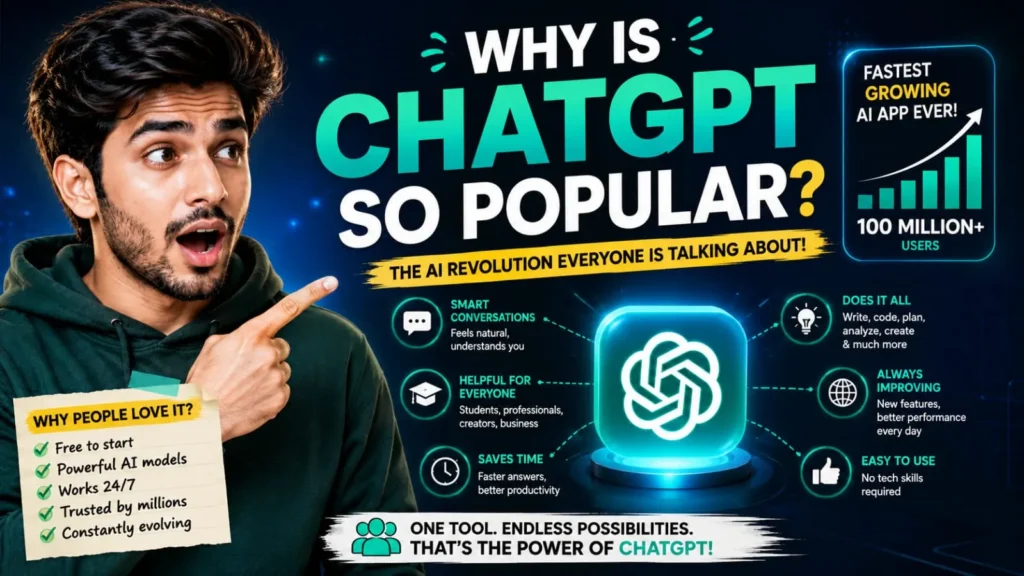
ChatGPT became the fastest app to reach 100 million users in history. Why? Because it actually works. It’s not just hype.
Before ChatGPT, getting smart AI responses required either being a developer or paying a lot of money for special tools. But ChatGPT made it free and easy. Anyone with an internet connection can go to chat.openai.com and start using it right away.
Another reason is that ChatGPT features are genuinely useful in real life. Students use it for homework help. Writers use it for content. Developers use it for coding. It’s not a toy, it’s a real productivity tool.
Who Should Use ChatGPT?
Honestly, if you’re reading this article, you should use ChatGPT. Whether you’re a student, a freelancer, a business owner, a teacher, or someone who just wants to save time, ChatGPT has something for you.
History of ChatGPT
Evolution of AI Chatbots
Development Timeline
After the original ChatGPT launch, things moved fast.
- March 2023: GPT-4 was released, bringing a massive improvement in reasoning.
- Late 2023: ChatGPT Plus users got access to image generation through DALL-E 3.
- 2024: Voice mode got much better. ChatGPT could now talk back with a natural human-like voice.
- 2025: ChatGPT got real-time web browsing, file uploads, data analysis, and much more.
- 2026: Now ChatGPT is one of the most advanced AI assistants in the world, with memory, custom instructions, and a massive context window.
How ChatGPT Works
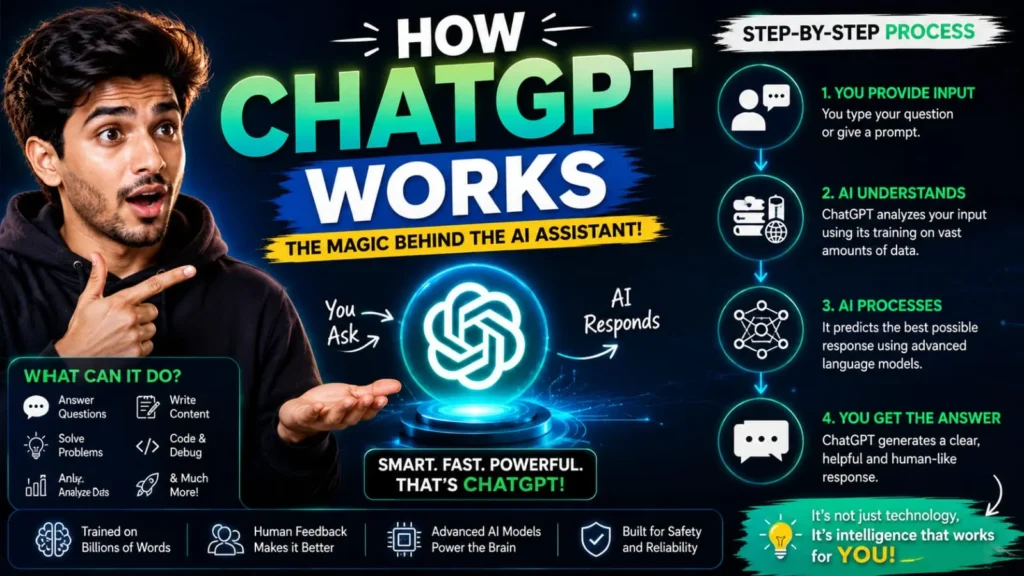
Artificial Intelligence and Large Language Models
Training Process
Token System and Context Window
Here’s something a bit technical but very useful to know. ChatGPT reads and responds in “tokens.” A token is roughly 3-4 characters of text. Every conversation has a “context window,” which is the total number of tokens ChatGPT can remember in one conversation.
GPT-4o, the latest model in ChatGPT as of 2026, has a very large context window. This means it can handle long documents, long conversations, and complex multi-step tasks without forgetting what was said earlier.
Key Features of ChatGPT
Text Generation
Image Generation
ChatGPT (with DALL-E 3 integration) can also create images from text descriptions. Just type “create an image of a futuristic Indian city at night,” and it will generate one. This is available on paid plans and limited on the free plan.
Voice Mode
This is one of the coolest ChatGPT features, in my opinion. You can speak to ChatGPT, and it speaks back. The voice sounds natural, not robotic. You can use it while driving, cooking, or just when you don’t want to type.
File Analysis
Upload a PDF, image, spreadsheet, or document, and ChatGPT will read and analyze it. Great for students who want to quickly understand a textbook chapter or professionals who need to summarize a long report.
Web Browsing
ChatGPT can now search the internet in real time. So even if something happened after its training cutoff, it can look it up and give you updated information. This is a game-changer for research.
Coding Assistance
You can ask ChatGPT to write code, explain code, fix bugs, and convert code from one language to another. Whether you’re working with Python, JavaScript, HTML, or something else, it handles it well.
Data Analysis
Upload a CSV file or Excel sheet and ask ChatGPT to analyze the data, create charts, find patterns, or write insights. This is basically like having a data analyst available 24/7.
Translation
ChatGPT can translate between dozens of languages with very high accuracy. It’s better than many translation tools because it understands context, not just individual words.
ChatGPT Free vs Paid Plans
Free Plan Features
The free plan gives you access to GPT-4o mini, which is honestly still very capable. You can have conversations, generate text, and do basic tasks. The limitation is that you get slower responses during peak hours and limited access to advanced features like image generation and web browsing.
Plus Plan ($20/month)
you have access to GPT-4o, which is much smarter. You get faster response speeds, access to DALL-E 3 for image generation, voice mode, file uploads, and web browsing. This is the plan most regular users go for, and honestly, $20 a month is worth it if you use ChatGPT daily.
Pro Plan ($200/month)
This is for power users and professionals. You get access to 01 Pro mode, which is the most powerful reasoning model from OpenAI. You also get higher usage limits and priority access to new features. This plan is best for developers, researchers, and heavy business users.
Team and Enterprise Overview
The team plan ($30/user/month) is great for small businesses. Enterprise is for large companies with custom needs, security requirements, and admin controls.
Which Plan is Best?
For beginners and casual users: The Free plan is enough to start.
For bloggers, students, and freelancers, the Plus plan is the sweet spot.
For developers and businesses: Team or Pro is worth considering.
How to Use ChatGPT Step by Step
Account Setup
- Go to chat.openai.com
- Click “Sign Up”
- Enter your email and create a password.
- Verify your email
- Done. You’re in.
That’s it. Takes less than 2 minutes. You don’t need to give a credit card for the free plan.
Basic Prompts
A prompt is just what you type to ChatGPT. For example:
- “Write a short email to my boss asking for a day off.”
- “Explain the water cycle in simple words.”
- “Give me 5 ideas for a birthday party.”
These are basic prompts. They work well for simple tasks.
Advanced Prompts
Best Practices
- Be specific about what you want.
- Tell it the tone (casual, formal, funny)
- Mention the audience (beginners, students, professionals).
- Ask it to revise if you don’t like the first answer
- Use follow-up questions in the same conversation.
Prompt Engineering Guide
What is a Prompt?
Good vs Bad Prompts
Bad prompt: “Write about social media.”
Good prompt: ” Write an impactful 300-word Instagram post caption for a fitness brand promoting a newly launched protein supplement, aimed at attracting fitness enthusiasts.” The target audience is gym-going Indians aged 20-30. Tone should be energetic and motivating.”
The second prompt has a clear goal, a specific output type, a target audience, and a tone. ChatGPT will produce something much more useful from that.
Prompt Formulas
Here are some proven prompt formulas you can use right away:
Formula 1: Role + Task + Format
“Act as a fitness coach. Write a 7-day diet plan for someone who wants to lose weight. Present it as a table.”
Formula 2: Context + Problem + Output
“I’m a beginner blogger. I’m writing about personal finance for Indians. Give me 10 blog title ideas that would rank on Google.”
Formula 3: Example-based
“Here’s an example of the writing style I want: [paste example]. Now write an intro paragraph for my article about [topic].”
Examples for Every Category
For Students:
” Describe the struggle for India’s freedom from 1857 to 1947 in simple language and explain the major events in detail.”
For Bloggers:
“Write an SEO-optimized intro paragraph for an article titled ‘Best Budget Smartphones Under 15000 in India 2026’.”
For Developers:
“Write a Python script that takes a CSV file as input and outputs the average of a specific column.”
ChatGPT Use Cases
Students
Students can use ChatGPT to:
- Understand complex topics in simple language.
- Get help with essay writing (but always rewrite in your own words).
- Create flashcards and study notes.
- Prepare for exams by asking practice questions.
- Understand math problems step by step.
In my experience, ChatGPT is like a patient tutor who never gets tired of explaining things.
Bloggers
Bloggers use ChatGPT for:
- Finding blog ideas and angles
- Writing outlines and first drafts
- Creating meta titles and meta descriptions
- Generating FAQ sections
- Improving existing content
YouTubers
YouTube content creators use it for:
- Writing video scripts
- Creating thumbnail text ideas
- Writing video descriptions and tags
- Coming up with video ideas for a channel
- Writing sponsored ad reads
Developers
Developers love ChatGPT because:
- It can write working code in almost any language.
- It explains what the code does, line by line.
- It finds and fixes bugs.
- It converts code between languages.
- It helps with documentation.
Digital Marketers
For digital marketing, ChatGPT is a complete ChatGPT productivity tool:
- Writing ad copy for Facebook, Google, and Instagram
- Creating email marketing campaigns
- Writing product descriptions for e-commerce
- Brainstorming campaign ideas
- Writing landing page copy
Freelancers
If you’re a freelancer, ChatGPT can help you:
- Write proposals to clients.
- Draft contracts in simple language.
- Speed up content delivery.
- Handle tasks outside your main skill set.
- Communicate better with clients in English.
Business Owners
Small business owners use ChatGPT to:
- Write professional emails.
- Create FAQs for their website.
- Generate business ideas.
- Plan social media content calendars.
- Prepare for customer queries.
Teachers
Teachers use ChatGPT to:
- Create lesson plans
- Make quiz questions
- Write easy explanations for difficult topics.
- Design project ideas for students
- Prepare presentation content
ChatGPT for Content Creation
Blog Writing
ChatGPT can write full blog articles, but you should always review, edit, and add your personal touch. Use it to generate a first draft and then polish it yourself. This saves hours of time.
SEO Articles
You can tell ChatGPT to write an SEO article targeting a specific keyword. It knows about keyword placement, heading structure, and readability. However, always run a final SEO check because it doesn’t always get keyword density perfectly right.
YouTube Scripts
Give ChatGPT your video topic and target audience, and it will write a complete YouTube script with a hook, main content, and call to action. This is one of the most popular ChatGPT use cases among content creators.
Social Media Captions
Need captions for Instagram, LinkedIn, or Twitter? ChatGPT writes them in seconds. Tell it the platform, the product or topic, and the tone, and it delivers.
Email Writing
Whether it’s a cold outreach email, a follow-up, a complaint, or a professional introduction, ChatGPT writes clear and effective emails. This alone has saved me probably 3-4 hours a week.
ChatGPT for SEO
Keyword Research
ChatGPT can help you find related keywords for any topic. It won’t show you search volume data like Ahrefs or SEMrush, but it gives great ideas for long-tail keywords, related terms, and People Also Ask questions.
Meta Title and Meta Description
Ask ChatGPT to write 5 meta title options and 5 meta description options for your article. Pick the best one. Simple.
Content Optimization
Give ChatGPT an existing article and ask it to suggest ways to improve the SEO, readability, and structure. It gives practical suggestions.
Internal Linking Ideas
Tell ChatGPT your website’s topic and the article you’re writing. Ask it to suggest what other topics on your site you should internally link to. Great for building a topical cluster.
ChatGPT for Coding
HTML and CSS
ChatGPT can build basic web pages from scratch. Tell it what you want, and it gives you the HTML and CSS code. Great for beginners learning web development.
JavaScript
Need a form validation script? A scroll animation? A dark mode toggle? ChatGPT handles these small JavaScript tasks easily.
Python
Python is where ChatGPT really shines. From simple scripts to data analysis to automation tasks, ChatGPT can write clean Python code with explanations.
Debugging
ChatGPT Tips and Tricks
Get Better Responses
- Start a new conversation for each new topic.
- Use bullet points in your prompts for structured output.
- Ask ChatGPT to “think step by step” for complex questions.
- Say “continue” if the answer gets cut off.
- Ask it to “be more concise” if the answer is too long.
Custom Instructions
Memory Feature
ChatGPT now has a Memory feature. It can remember facts about you across different conversations. You can also manually tell it things to remember: “Remember that I am a vegetarian” or “Remember that my blog is called TechAllRounder.”
Productivity Hacks
- Use ChatGPT for your morning to-do list.
- Ask it to summarize long documents before reading them.
- Use it to prepare for meetings or interviews.
- Ask for a “devil’s advocate” perspective when making decisions.
- Use it as a brainstorming partner when you feel stuck.
Common Mistakes to Avoid
Overtrusting AI
ChatGPT is smart, but it’s not always right. Don’t blindly trust everything it says. Always verify important facts, especially in finance, health, or legal matters.
Poor Prompts
Most bad ChatGPT experiences come from bad prompts. If you ask something vague, you’ll get something vague. Take 30 extra seconds to write a clear, specific prompt.
Not Fact-Checking
ChatGPT can sometimes say things that sound very confident but are actually wrong. This is especially true for recent events, statistics, and specific names or dates. Always double-check before publishing.
Privacy Mistakes
Don’t share personal information like your Aadhaar number, bank details, passwords, or sensitive business information with ChatGPT. It’s a public AI tool, and you don’t fully control where that data goes.
ChatGPT Limitations
Hallucinations
This is the biggest problem with ChatGPT. Sometimes it “hallucinates,” meaning it makes up facts that don’t exist. It might cite fake research papers or give wrong statistics. This is not intentional; it’s just how LLMs work sometimes.
Outdated Information
Without web browsing, ChatGPT’s knowledge has a cutoff date. It won’t know about things that happened after its training. With web browsing enabled, this is less of an issue, but still something to keep in mind.
Bias
Since ChatGPT was trained on internet data, it can reflect certain biases present on the internet. It tries to be balanced, but it’s not perfect. Be critical when asking for opinions or analysis on sensitive topics.
Context Limitations
Even with a large context window, very long conversations can sometimes cause ChatGPT to “forget” what was said earlier. If you’re working on a very long project, start fresh conversations or paste the key context again.
Privacy and Security
Data Handling
Safe Usage Tips
- Don’t share private business plans or client data.
- Don’t paste code that contains API keys or passwords.
- Use Temporary Chat mode for sensitive conversations (it doesn’t save history)
- Log out of shared devices after use.
ChatGPT Alternatives
Let me be honest here. ChatGPT is not the only good AI assistant out there.
Google Gemini: Great for Google Workspace integration. Works well with Gmail and Google Docs.
Claude (by Anthropic): Excellent for long documents and very thoughtful, nuanced answers. Many writers prefer Claude for its tone.
Microsoft Copilot: Best if you’re already using Microsoft 365. Integrated into Word, Excel, and Teams.
Perplexity AI: The best option for real-time web search and research. Cites its sources very clearly.
Grok (by xAI): Good for up-to-date information and has a fun, edgy personality. Great for Twitter/X users.
Each tool has its strengths. I personally use ChatGPT and Claude the most in my day-to-day work.
Future of ChatGPT
Upcoming AI Trends
AI is moving incredibly fast. In the next 1-2 years, we’ll likely see:
- Even larger and smarter language models
- Better multimodal AI (understanding text, image, audio, and video together)
- More personalized AI that knows your preferences deeply
- AI agents that can complete multi-step tasks on your behalf automatically
Expected New Features in ChatGPT
OpenAI is working on more advanced memory, better reasoning models, and deeper integration with third-party apps. We may also see ChatGPT on more devices and platforms.
AI in Everyday Life
By 2027-2028, AI assistants like ChatGPT will probably be as common as smartphones. They’ll help us in healthcare, education, government services, and personal productivity in ways we can barely imagine today. If you start learning how to use ChatGPT now, you’re ahead of the curve.
Conclusion
Alright buddy, that was a complete ChatGPT tutorial covering everything from what it is and how it works to its features, free vs paid plans, and real-world use cases and tips.
The bottom line is this: ChatGPT is one of the most powerful tools available to regular people right now. It saves time, boosts creativity, and makes you more productive in every field. But the key to getting the most out of it is knowing how to use ChatGPT properly, and now you do.
If you’re a student, start using it for study help. If you’re a blogger or writer, use it to speed up your content workflow. If you’re a developer, use it to write and debug code faster. And if you’re a business owner, use it to handle the endless small tasks that take up your day.
The one thing I want you to take away from this article: Don’t just open ChatGPT and type random things. Use good prompts, be specific, and treat it like a smart assistant who needs clear instructions.
Now go try it. And trust me, once you start using it the right way, you won’t want to go back.











FAQ's
Is ChatGPT free to use?
Yes, ChatGPT has a free plan that gives access to GPT-4o mini with basic features. Paid plans like Plus offer more advanced tools and faster responses.
Can ChatGPT replace Google Search?
Not completely. ChatGPT is great for detailed answers and writing help, but Google is better for finding links, real-time news, and local results. Both have different strengths.
Is ChatGPT safe to use for students?
Can ChatGPT write real working code?
Yes, ChatGPT can write functional code in HTML, CSS, JavaScript, Python, and many other languages. It’s one of the most popular ChatGPT use cases for developers.
Can ChatGPT create images?
Yes, through DALL-E 3 integration, ChatGPT can generate images from text descriptions. This feature is available on the Plus and Pro paid plans.
How is ChatGPT Plus different from the free plan?

Deepak Kumar is the founder and author of Techallrounder.com. He covers the latest technology news, smartphone and laptop reviews, gadget comparisons, buying guides, and tech tips. His goal is to provide accurate, easy-to-understand, and up-to-date information that helps readers make better technology decisions.