
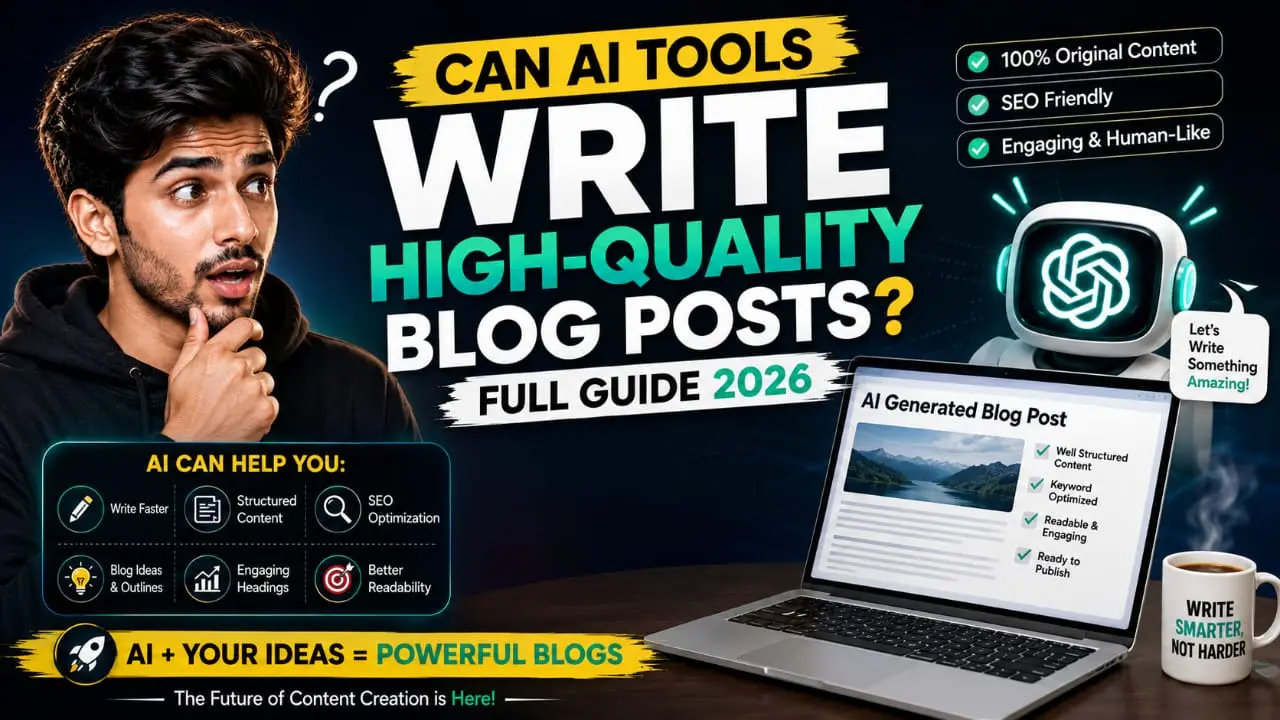
Introduction: The question that every blogger is asking nowadays
What is that question? Can AI tools write high-quality blog posts? To be honest, this is a question that almost every week my friends who are bloggers, content creators, and digital marketers ask me. And I can completely understand in detail why people are so confused about this.
A few years ago, if someone came up to me and said that a machine could write an entire blog post in high quality, I would have laughed at that time. But the situation today is completely different. AI writing tools are everywhere, and they are getting better every month.
Honestly, friend, AI tools can write blog posts. But whether these posts are actually “high-quality” or not depends on a bunch of different things. It depends on how you use the tool, what kind of topic you’re writing about, and how much human touch you add after the AI is done.
In this entire article, we’ll cover everything well. We’ll talk about the best AI writing tools available right now, how AI content creation works for you, whether AI blog posts rank on Google, and when you should still rely on a human writer. By the end, you’ll have a really clear, close-to-real picture of it.
So, let’s take a look at it from our perspective.
In This Article
ToggleHighlights at a Glance
| Topic | Key Point |
|---|---|
| Can AI write blog posts? | Yes, but with human editing |
| Best use case | First drafts, outlines, ideation |
| SEO performance | Good if optimized properly |
| Best AI writing tools | ChatGPT, Jasper, Copy.ai, Writesonic |
| Human touch needed? | Absolutely yes |
| Recommended for beginners? | Yes, great starting point |
How Much Does AI Writing Cost?
| ChatGPT | Yes (GPT-3.5) | $20/month (Plus) |
| Jasper AI | No | Starts at $39/month |
| Copy.ai | Yes (limited) | $36/month |
| Writesonic | Yes (limited) | Starts at $16/month |
| Rytr | Yes | $9/month (Saver) |
What Exactly Are AI Writing Tools?
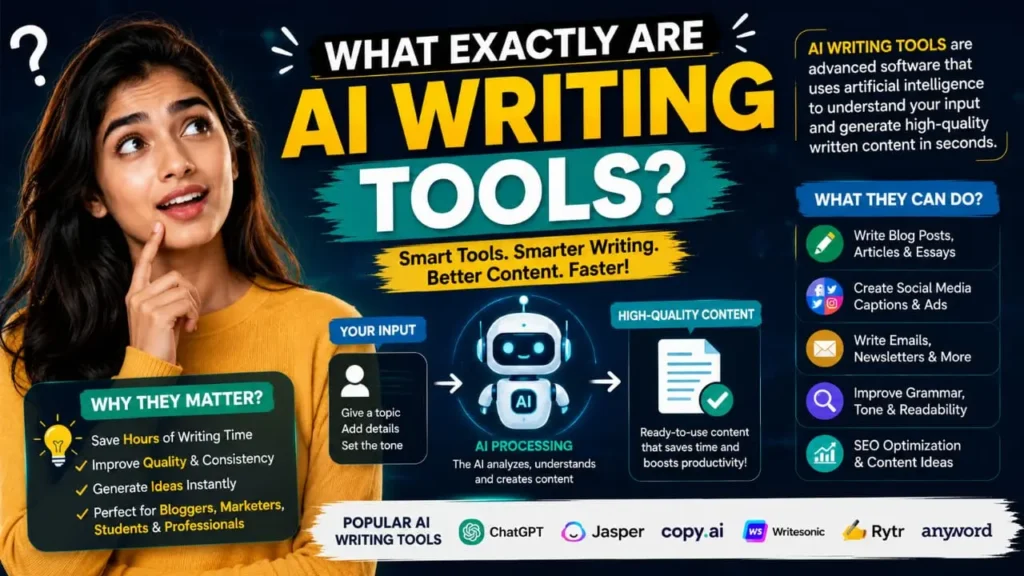
Before diving deeper, let’s make sure we’re both on the same page. AI writing tools are software programs that use artificial intelligence to generate text. They are trained on huge amounts of data from the internet, books, and other written content.
You give them a topic, a keyword, or a short prompt. They then generate paragraphs, full articles, product descriptions, social media posts, and much more.
So here’s the thing most people don’t really notice. These tools are not actually “thinking.” They are predicting the next best word based on patterns they learned during training. This is why AI content can sometimes feel a bit generic or repetitive if you do not guide it properly.
But when used the right way, these tools can seriously speed up your content creation process. I personally use them to get a rough first draft done in minutes, and then I spend time polishing it to make it feel more human.
Can AI Tools Write High-Quality Blog Posts for SEO?
This is the big question, right? Let’s break it down honestly.
What AI Does Really Well for SEO Blog Writing
Tell me the truth: when it comes to SEO blog writing with AI, there are some things these tools genuinely do well.
1. Keyword Placement
AI tools are pretty good at naturally including your focus keyword throughout an article. If you give them the right instructions, they will use it in the intro, in headings, and throughout the body without stuffing it awkwardly.
2. Article Structure
One thing I really like is how AI handles structure. Give it a topic, and it will quickly organize the article into H1, H2, and H3 headings. This saves a lot of planning time and helps with readability, which Google loves.
3. Generating Ideas and Outlines
Honestly, this might be where AI tools shine the most. When you are stuck and do not know where to start, just ask an AI tool to give you an outline. It will suggest sections, subheadings, and even FAQs that you might have missed. This alone is worth using these tools for.
4. Writing Meta Descriptions and Titles
AI is surprisingly good at writing click-worthy titles and meta descriptions that include keywords naturally. This directly helps with your SEO click-through rate.
5. Long-form Content at Scale
If you run a content website and need to publish regularly, AI content creation lets you produce a large volume of articles much faster. For a website like techallrounder.com, this is a huge advantage.
Where AI Falls Short in Blog Writing
Okay, now let’s talk about the not-so-good parts. Because I believe in giving you the full, honest picture.
1. Lack of Real Experience
AI has never actually used a smartphone, eaten food, or traveled anywhere. So when you ask it to write a review or a personal experience-based article, it can only fake it. The content might sound okay on the surface, but it will not have that genuine feel that readers connect with.
In my experience, readers can often sense when an article feels “off,” and they click away quickly. This hurts your bounce rate and eventually your rankings too.
2. Outdated Information
Most AI models have a knowledge cutoff date. This means they may not know about the latest phone launches, current prices, or recent news. For a tech blog or current affairs website, this is a serious problem if you use AI without doing your own research first.
3. Repetition and Filler Content
AI loves to repeat ideas in different words. You will often see it say the same thing three or four times in slightly different ways. This is called filler content, and it lowers the overall quality of the article. You need to manually clean this up.
4. No Unique Opinions
This is a big one. Google is now heavily rewarding content that shows E-E-A-T, which stands for Experience, Expertise, Authoritativeness, and Trustworthiness. Pure AI content lacks the “Experience” part completely. It cannot share a unique point of view or an original opinion that comes from real-world experience.
Are AI-Generated Blog Posts Good for Google Rankings?
This is something a lot of people wonder about. And the honest answer is, it depends.
Google has said publicly that they do not automatically penalize AI-generated content. What they care about is whether the content is helpful, accurate, and original. If an AI article meets those standards, it can rank well.
However, if you just copy-paste whatever an AI tool generates without editing it, chances are it will not rank. Here is why:
The content may be too generic and not unique enough. It may lack depth on specific topics. It will not have real personal experience or unique insights. It might miss current information that users are looking for.
Now, if you use AI as a writing assistant and then add your own knowledge, real data, personal experience, and proper optimization, the article can absolutely rank on Google. Many bloggers and SEO professionals are doing this successfully right now.
If you also think like me, you’ll think of AI as a tool, not as something that replaces anything. A hammer does not build a house by itself. You still need the person holding it.
The Best AI Writing Tools Available Right Now
Let’s talk about the real tools you or your friends can use. These are the most popular and reliable options for AI content creation today.
1. ChatGPT (by OpenAI)
I think ChatGPT is probably the most popular AI writing tool in the world. It is incredibly versatile. You can ask it to write a full blog post, refine specific sections, suggest headings, or even rewrite a paragraph in a more casual tone.
The free version (GPT-3.5) is decent, but the paid version with GPT-4 or GPT-4o is noticeably better for quality and accuracy. For bloggers and content creators, ChatGPT is a great all-around choice.
Best for: Full blog drafts, brainstorming, editing, and Q&A style content
Limitation: No real-time internet access on the basic plan (you need the browsing feature for current info)
2. Jasper AI
Jasper was made specifically to help with marketing and content writing. It has templates for blog posts, ad copy, product descriptions, emails, and more. It also integrates with SurferSEO, which helps you optimize your content for search engines as you write.
Jasper is a bit more expensive compared to other AI options, but it has become one of the most powerful tools for professional content teams and marketers.
Best for: Marketing teams, agencies, and professional bloggers who need high-volume content
Limitation: Pricey for solo bloggers or beginners
3. Copy.ai
Copy.ai is a good option for people who need quick content without a steep learning curve. It’s a bit easy to use, and it also comes with a good free plan. It is better for shorter content like social media posts, product descriptions, and email copy, but it can handle blog posts too.
Best for: Beginners and small business owners
Limitation: Less powerful for long-form in-depth articles
4. Writesonic
If you look at it, Writesonic has become one of the cheapest paid AI writing tools. It supports multiple content types including blog posts, landing pages, ads, and more. It also has a feature called “Article Writer” that can generate a full SEO-optimized blog post from just a keyword.
Best for: Bloggers on a budget who want good quality output
Limitation: Quality can vary depending on the topic
5. Rytr
According to this list, Rytr is one of the most affordable options. It is simple, fast, and easy to use. For someone who is just starting out and wants to experiment with AI content creation without spending much money, Rytr is a solid choice.
Best for: Beginners, freelancers, and budget-conscious writers
Limitation: Limited features compared to Jasper or ChatGPT
AI vs Human Writers: Which is Better?

Now let’s talk about the big debate. AI vs human writers. Which is actually better?
Honestly, this is not really a fair comparison because they both serve different purposes.
Where AI Wins
Speed: AI can produce a 1500-word draft in under 2 minutes. Cost: Much cheaper than hiring a professional writer for every article. Consistency: AI does not have bad days, writer’s block, or emotional distractions. Scale: You can produce 10 articles in the time it would take a human to write 1.
Where Human Writers Win
Personal experience and storytelling that feels real. Understanding of cultural context, humor, and local references. Original opinions and unique perspectives. Ability to fact-check and include current information. Building a real connection with readers.
So, the smartest approach right now is to combine both. Use AI to handle the heavy lifting of drafting, structure, and basic SEO optimization. Then bring in human editing, personal insights, real data, and your own voice to make it truly great.
This is exactly what the most successful content creators are doing these days. They are not choosing AI or humans. They are using both together.
How to Use AI Tools to Write Professional Blog Articles
Okay buddy, let’s get practical. Here is a step-by-step approach I personally use when writing blog posts with AI assistance.
Step 1: Start With a Clear Topic and Keyword
Before you open any AI tool, decide on your focus keyword and the main goal of the article. Get to know your competitor’s audience well and figure out what problem they’re trying to solve. This makes your AI prompt much more effective.
Step 2: Write a Detailed Prompt
Do not just type “write a blog post about AI writing tools.” Be specific. Tell the AI your target keyword, the tone you want, the word count, and any specific points you want covered. The more detailed and effective your prompt is, the better the output will be.
For example: “Write a 2000-word helpful blog post targeting the keyword ‘Can AI tools write high-quality blog posts? ‘ Use a helpful, conversational tone. Include sections on SEO benefits, limitations of AI writing, and a comparison with human writers.”
Step 3: Generate the First Draft
Let the AI do its thing. Read through the output carefully. Do not just blindly accept it. Look for sections that feel weak, repetitive, or off-topic.
Step 4: Add Your Personal Touch
This is the most important step. Go through the draft and add your own opinions and experiences, specific examples or case studies, current data or statistics, local context if needed, and natural phrases that sound like you.
This is what separates a generic AI post from a genuinely good one.
Step 5: Optimize for SEO
Once the content is good, make sure your focus keyword appears in the title, the first 100 words, at least one H2 or H3 heading, and naturally throughout the body at 1 to 2 percent density. Also check meta description, alt tags for images, and internal linking.
Step 6: Run a Readability Check
Use tools like Hemingway App or the readability checker in RankMath to make sure the content is easy to read. Aim for a Grade 6 to 8 reading level for most blog audiences.
Step 7: Plagiarism and AI Detection Check
Before publishing, run the article through a plagiarism checker. Also, if you are worried about Google or clients flagging it as AI-written, tools like Humanize AI or Undetectable.ai can help make the text feel more natural.
Common Mistakes People Make With AI Blog Writing
Let me share some mistakes I see bloggers making all the time when they use AI tools.
Mistake 1: Publishing Without Editing
This is the biggest one. Just because AI wrote it does not mean it is ready to publish. Always edit, always add your voice, always fact-check.
Mistake 2: Over-Relying on AI for News and Current Events
AI does not know what happened last week. For news sites, tech review blogs, and current affairs websites, always verify facts manually before publishing.
Mistake 3: Using the Same Prompt for Every Article
If you use a basic generic prompt every time, you will get generic results every time. Take a few extra minutes to write a detailed, specific prompt, and you will get much better output.
Mistake 4: Ignoring E-E-A-T Signals
Google wants to see real expertise and real experience. If every single article on your blog is pure AI with no author credentials, no personal stories, and no original research, your site will struggle to rank in competitive niches.
Mistake 5: Keyword Stuffing
Some people think that since AI can include keywords anywhere, they should push the density as high as possible. This is wrong. Stick to 1 to 2 percent keyword density. Google penalizes keyword stuffing just as much as it used to.
AI Blog Writing Tools for Beginners and Marketers
If you are just starting out, the whole world of AI content creation can feel a bit overwhelming. So here is my honest suggestion for beginners.
Start with the free ChatGPT plan. Get comfortable writing prompts, editing output, and understanding what good AI content looks like versus what needs work. Once you get the hang of it, you can explore paid tools like Writesonic or Jasper depending on your budget and needs.
For marketers who need to produce content at scale, Jasper with SurferSEO integration is probably the most powerful combination available right now. It lets you write, optimize, and publish faster than almost any other workflow.
For small business owners who just need occasional blog posts, Copy.ai or Rytr will get the job done without breaking the bank.
AI Content Quality: What Does "High Quality" Even Mean?
This is something worth thinking about for a minute. When we say “high-quality blog post,” what are we actually looking for?
Here is my personal checklist for a high-quality blog post, whether it is written by AI, a human, or both: it answers the reader’s question clearly and completely, it is easy to read and understand, it is structured well with proper headings, it includes accurate and current information, it has a clear point of view or helpful recommendation, it feels genuine and not robotic, it is optimized for search engines without feeling forced, and it loads fast and has good formatting.
Now here is the honest truth. AI can help you hit most of these checkboxes. But the “genuine” and “point of view” parts? Those still need a human.
My Personal Experience Using AI for Blog Writing
I want to share something with you from my own content journey. When I first started using AI tools for blog writing, I was honestly skeptical. I thought the content would feel fake and that readers would notice.
But then I tried something different. Instead of asking AI to write everything, I started using it just for the outline and the rough draft. Then I sat down and rewrote the introduction in my own words, added real examples from my experience, and cleaned up any repetitive sections.
The result was much better. The article was published faster, it ranked well, and readers actually engaged with it.
That experience changed how I look at AI tools. They are not competitors to good writing. They are tools that make good writing easier and faster. The human creativity, honesty, and experience still need to come from you.
Final Verdict: Can AI Tools Write High-Quality Blog Posts?
So, let’s tackle this with a clear, honest answer.
Yeah, AI tools can write high-quality blog posts if you look at it, but not completely on their own. The best results really come out when you use AI as your writing partner, not as a substitute for your own thinking and creativity.
Here’s my simple three-point brief info:
Use AI:
To create initial drafts and outlines
For keyword optimization suggestions
To generate title and meta description ideas
To boost your content production
Use human effort:
Personal stories and real experiences
For current and accurate facts
Unique opinions and recommendations
Final editing and quality checks
Avoid:
Publishing raw AI content without editing
Relying too much on AI for news and current topics
Ignoring E-E-A-T in your overall content strategy
The future of blogging isn’t just AI or just humans. It’s about AI and humans working together. If you can get that balance, you’ll be in a really strong spot as a content creator.
Good luck, friend. And remember, the best blog posts are always the ones that truly help your reader solve all their problems. Whether AI played a part or not doesn’t matter as much as whether it actually provides real value.











FAQ's
Can AI tools write high-quality blog posts on their own?
Are AI-generated blog posts good for Google rankings?
Which is better for blogging, AI or human writers?
How to use AI tools to write professional blog articles?
Does Google penalize AI-written blog content?
What are the best AI writing tools for blog posts?

Deepak Kumar is the founder and author of Techallrounder.com. He covers the latest technology news, smartphone and laptop reviews, gadget comparisons, buying guides, and tech tips. His goal is to provide accurate, easy-to-understand, and up-to-date information that helps readers make better technology decisions.